Some intellectual property (IP) rights arise automatically under certain circumstances while others require affirmative action.
PRACTICAL TIP: Think about IP early to avoid waiving potential rights and consider the benefits of optional protections.
Copyrights
Copyright attaches automatically to the author when a new creative work (e.g., text, photo, etc.) is fixed in a tangible medium of expression. Registration is not required for copyright to exist. Copyright ownership is also independent of possession and ownership of a copy of a work—even the “original” or sole copy.
Trademarks
Trademark rights can arise through use of a mark to identify the source of goods or services, provided that the mark is distinctive. Registration is not required to have enforceable trademark rights in the U.S. However, registration of a mark, particularly a federal registration on the Principal Register, helps to secure rights through the entire country and over time can limit the possibility for others to challenge the trademark rights in the registration.
Trade Secrets
Trade secret rights can attach to information that derives economic value from not being generally known and not being readily ascertainable so long as you take reasonable measures to keep it secret, meaning the existence of trade secret rights depends on the affirmative steps you take to maintain secrecy.
Patents
Patent rights require applying for and then obtaining a patent following an examination to determine if the invention satisfies criteria for patentability, which include novelty and nonobviousness. In the U.S., a patent must be applied for within one year of any disclosure, public use, or commercialization of the invention by the inventor. In most other countries, a patent must be applied for before any public disclosure.
International Considerations
Patent and trademark rights are territorial and rights in the U.S. will generally not provide exclusive rights abroad. Copyright and trade secret rights may have international enforceability in both the U.S. and some foreign jurisdictions.
Assignments and Licenses
IP rights can also be obtained from others via assignment (i.e., a transfer of ownership) or licensing (i.e., authorization to use the IP without a transfer of ownership). For many types of IP, assignments must be in writing and/or satisfy other criteria to be valid. Trademark rights are tied to underlying customer goodwill and cannot be assigned apart from that goodwill. A “naked” assignment of a trademark without associated goodwill can result in abandonment, as can licensing without quality control.
Employee- and Vendor-Created IP and Joint Development
When employees create things that may be subject to IP rights, the general rule—with some exceptions (notably for copyrightable works made for hire created by an employee within the scope of his or her job duties)—is that the employee rather than the employer is the owner. Businesses wanting to obtain ownership of employee-created IP should consider a written agreement (e.g., employment agreement) that establishes either an obligation to assign IP (to be followed later by execution of an assignment) or a prospective assignment of expected future IP.
When hiring a vendor to create or develop something, or jointly developing something with a business partner, consider who will own the IP at the outset. Merely paying for development will not automatically result in the transfer of ownership of vendor-created IP. Joint development can raise complex questions about who will own what, and ownership of particular IP may depend on which person(s) or entity contributed to that particular subject matter in the absence of a written agreement.
A common mistake is to ignore ownership of IP rights until there is infringement or a big business deal. Attempting to “fix” or alter IP ownership after the fact is usually much more complicated than sorting that out from the start of a vendor/partner/employee relationship (or even at the start of a particular project).
Austen Zuege is an attorney at law and registered U.S. patent attorney in Minneapolis whose practice encompasses patents, trademarks, copyrights, domain name cybersquatting, IP agreements and licensing, freedom-to-operate studies, client counseling, and IP litigation. If you have patent, trademark, or other IP issues, he can help.
Trademark law can protect a brand name (in words), graphical logo, or the like—a “mark”—used to identify the source of goods or services. But not all marks are protectable. It is not unusual for a first-choice mark (and second-choice…) to already be taken or simply not be protectable. The following is an explanation of the basics of how a business’ name and logo can be protected under trademark law.
The first step is to select a mark that is distinctive enough to be protectable. Generic terms (or functional aspects) are never entitled to protection under trademark law. Merely descriptive terms are not protectable but descriptive marks can potentially develop “secondary meaning” and acquire distinctiveness in consumers’ minds over time, through extensive use and promotion, so as to become protectable. Suggestive, arbitrary, or fanciful marks are inherently distinctive and thus always protectable. Arbitrary and fanciful marks have the greatest legal strength, in conceptual terms.
A common problem is that businesses select marks that are not conceptually strong enough to merit exclusive rights as trademarks. Businesses people are frequently drawn to descriptive or generic terms for marketing purposes because they require less initial investment to obtain consumer recognition, or as an attempt to appropriate pre-existing consumer recognition. But the tradeoff is that generic and descriptive marks are considered conceptually “weak” and offer less or no legal exclusivity. In this respect, business and marketing interests and tendencies can be in tension with trademark law. If exclusive trademark rights are important to your business, make sure you select a mark that is good enough in legal terms to be protectable under trademark law.
Keep in mind that a mark must be one specific thing. Materially different spellings or visual depictions potentially reflect use of different marks. It is possible to have multiple different marks that are each in use, potentially even simultaneously with the same goods or services. But consistency in usage is important. This generally means settling on the exact mark or marks that will be used and sticking to those decisions.
Secondly, U.S. trademark rights generally go to the senior user. This means many marks are already taken by others, which limits the universe of marks freely available for your business’ use at the time of adoption. If your business’ mark creates a likelihood of confusion with an existing mark, the prior user will have superior rights. There can be a likelihood of confusion even if there are differences between the respective marks or goods/services, and evidence of actual confusion in the market is not required. Also, a protectable but commercially weak mark, such as one that resembles numerous other coexisting marks, will have more limited scope of exclusivity than a stronger mark.
Geographically separate but otherwise similar uses of trademarks can sometimes coexist. Although businesses operating on the Internet tend to encompass wide geographic areas of use without much opportunity for separation. Moreover, a prior user might consent to coexistence in some circumstances—often subject to certain conditions to avoid confusion, such as agreements limiting the scope of the goods/services with which a mark is used. But, in general, the possibility of coexistence or consent is very context-specific and cannot simply be assumed to be possible.
Trademark rights in the U.S. arise from commercial use of a mark. “Common law” rights can accrue automatically through use of a mark but are generally limited to the geographic area in which the mark is actually used. Registering a mark has benefits, and a federal registration on the Principal Register can secure rights over the entire country and can be used to prevent unauthorized importation of goods bearing the mark. Federal registration generally requires use in interstate commerce, territorial commerce, or foreign/tribal commerce (with a limited exception if a foreign registration exists).
Trademarks are also territorial. Rights in one country generally provide no exclusivity in another. But most countries have no use requirement; many follow a first-to-file system and may provide little or no rights based on use alone. Therefore, the first entity to register may prevail in other countries. Also, many other countries are more restrictive than the U.S. in terms of the level of distinctiveness required for a mark to be registrable.
After adoption of a mark, use it properly and consistently, and monitor for potential infringing uses. Additional steps can also be taken to enhance protection of a trademark.
Trademark rights can potentially last indefinitely if still in use but can be abandoned through nonuse without intention to resume. Federal rights are presumptively abandoned after three years of nonuse. A branding “refresh” or other changes to a mark may result in the loss of existing trademarks rights and/or registrations and be treated as the adoption of a new mark or marks. Moreover, reduction in the goods and services with which a mark is used can lead to partial abandonment (just as expansion of use can potentially lead to new infringement risks).
Useful Tips:
Use care when selecting a mark to avoid having to later re-brand, which becomes more burdensome over time. Identify and evaluate potentially conflicting existing marks as part of initial mark selection. In doing so, consider all jurisdictions and scenarios under which your business plans to operate, including likely future expansion as to goods/services and geographic areas. A trademark legal clearance can help identify potentially conflicting marks and associated infringement risks.
Registration of an Internet domain name, a corporate name (trade name), an assumed name (d/b/a), or even all of them, does not alone establish any exclusive rights in a brand or mark under trademark law.
Austen Zuege is an attorney at law and registered U.S. patent attorney in Minneapolis whose practice encompasses patents, trademarks, copyrights, domain name cybersquatting, IP agreements and licensing, freedom-to-operate studies, client counseling, and IP litigation. If you have patent, trademark, or other IP issues, he can help.
The process to register a trademark (or service mark) involves submitting an application, which is then substantively examined and a registration is ultimately either issued or refused. Post-registration action is required to maintain a registration, which can potentially last indefinitely provided that the registered mark is still in use. Both federal and state trademark registrations are available in the USA, and registration is also available in foreign countries. In many jurisdictions, including for U.S. federal applications, marks are published for potential opposition by others prior to registration. Trademark registrations are also subject to cancellation (or expungement, etc.) under certain circumstances.
Federal registrations are handled by the U.S. Patent & Trademark Office (USPTO), which oversees two registers: the Principal Register and the Supplemental Register. Only registration on the Principal Register establishes a presumption of exclusive rights in a mark.
Not all Registrations are Equal in the U.S.: Federal trademark registration on the Principal Register is almost always preferable to state registration because much more expansive national rights are obtained, which is significant in the age of the Internet. Also keep in mind that a federal registration on the Supplemental Register does not by itself establish exclusive rights, although it can block a later conflicting registration. The value of state-level registrations varies. Some state trademark registrations provide no presumption of exclusive rights.
Basic Requirements of a Federal U.S. Trademark Application
A U.S. federal trademark application must identify the mark, the associated goods and/or services, and a filing basis.
Identification of Mark
The identification of the mark establishes what, exactly, constitutes the mark, which can include words (e.g., in “standard characters”) and/or graphical elements (e.g., color, stylized typeface/font, design element(s)), depending on the nature of the mark. Importantly, a mark must be one specific thing. Different spellings or different visual depictions potentially represent different marks. A trademark application must be limited to one mark, with any other potential marks pursued in separate applications.
Identification of Goods and Services
The goods and services must be identified and grouped according to a classification system, with filing fees calculated based on the number of classes of goods/services included. There is some skill involved in wording these identifications of goods and services appropriately. One important consideration is that for U.S. federal registrations it is not possible to simply “reserve” a mark, that is, merely to block others from using it. Use of the mark with all the identified goods and services must have already occurred or at least be intended in the future. Therefore, crafting a proper identification of goods and services requires first understanding how the applicant is currently using and/or legitimately intends to use the mark.
Filing Basis
As to filing bases, first, an application can be based on actual use in commerce, that is, the mark is already in use. Evidence of use in the form of a “specimen” must be submitted with such an application and the date of first use in commerce must be specified.
Alternatively, a federal application can be filed based on a bona fide intent-to-use (ITU). In this case, the mark has not yet been used in commerce but the applicant has a good faith intention to do so. The ITU application filing date establishes constructive use in commerce. But a statement of use (with a specimen) is still eventually required in an ITU application in order to obtain a registration—with paid extensions of time the applicant has up to about three years to do so.
Federal U.S. registrations based upon prior foreign registrations and applications as well as Madrid Protocol extensions based on a foreign application or registration are also possible. Having a foreign registration allows a U.S. registration to be granted without establishing use of the mark in the U.S.
Lastly, it is possible for a given application to include multiple filing bases. This is most common when a mark has already been used with some but not all goods or services, but use with the further goods/services in the future is intended. It is also common when priority to a foreign trademark registration or application is involved but usage varies (or will vary) between the U.S. and foreign country varies.
The Examination Process
Trademark office examination involves a search for conflicting registrations and an analysis of whether the applied-for mark meets applicable legal criteria. This is called trademark “prosecution”. Applicants can respond to any refusal sent in an “office action” by making amendments and arguments. Appeals from refusals are also possible. Additionally, even if a trademark examiner believes a mark is registrable, third parties can oppose registration and can later challenge an issued registration.
Federal registrations can take anywhere from a matter of months to years to obtain, provided that the mark is registrable at all. The timeline tends to be longer when there is a refusal (for instance, based on a prior conflicting registration or application) or an opposition to registration is lodged. State registrations may take only a matter of days to weeks, provided the mark is registrable. Foreign registration timelines vary widely.
Helpful Tips:
Although U.S. applicants can apply for registration themselves, subject to identity verification, legal advice from a knowledgeable attorney can help in obtaining the best and most appropriate coverage. Foreign trademark applicants are generally required to hire a licensed U.S. attorney.
Registrations of word marks in “standard characters” are usually the broadest because they do not include any limiting claim as to color, font, or other stylization or graphical elements in a mark that includes one or more words. On the other hand, words that are unregistrable in standard characters alone can sometimes become registrable when distinctive graphical elements are added as part of a “composite” mark that includes both word(s) and graphical element(s).
Consider the effect of expanded, reduced, or otherwise changed use of a mark over time. Such changes may may suggest pursuing one or more additional registrations. Some changes may also affect the ability to maintain an existing registration (e.g., due to a substantial changes to a graphical logo or ceasing use with certain goods/services).
State-level registration might be worthwhile if usage does not qualify for federal registration, such as purely local usage that is not part of interstate commerce.
Trademark registrations are territorial. A registration in one country will generally not provide exclusive rights in any other country. Consider foreign registration(s) if a mark is or will be used in multiple countries.
Registrations are generally even more important in other countries, where trademark rights are often determined on a first-to-register basis—sometimes without regard to priority of actual use.
For example, unrelated companies concurrently using similar brands in two different countries but later expanding to a common third country can sometimes lead to disputes.
As another example, outsourced manufacturing can also sometimes lead to trademark disputes. Export-only manufacturing in a foreign country of goods having trademarks applied to them maystill be considered trademark use under foreign law (e.g., “OEM” manufacturing in China), even without any local commercial sales in that foreign country.
Austen Zuege is an attorney at law and registered U.S. patent attorney in Minneapolis whose practice encompasses patents, trademarks, copyrights, domain name cybersquatting, IP agreements and licensing, freedom-to-operate studies, client counseling, and IP litigation. If you have patent, trademark, or other IP issues, he can help.
Intellectual property (IP) rights might allow a business to obtain exclusive rights in some or all aspects of a product. Such IP rights can potentially include patents, trademarks (i.e., trade dress), copyrights, and trade secrets. But the types of IP that might apply will vary depending on the context of the product involved, and may require affirmative action to secure and maintain IP rights.
Consider patentability before any public disclosure or commercialization of a product in order to avoid potential loss of patent rights. Although other types of IP protection might be available, exclusivity in the design of a new useful product is first and foremost a question of potential patent protection.
Patent Protection
Patents can provide exclusive rights for a limited time in exchange for disclosure of an invention. An inventive product—and/or a process or method associated with making or using it—can be protected with a utility patent. However, a patent application must be filed within one year of public disclosure or commercialization (or, in other countries, before any public disclosure). The invention must also satisfy three criteria for patentability: utility, novelty, and non-obviousness. The latter two criteria depend on the scope and content of the prior art. A patentable invention cannot already be known and must represent a non-trivial advance over what was already known. These assessments are made in an absolute sense. Prior art is not limited to commercially available products. And it does not matter whether or not the inventor actually knew about the relevant prior art.
The ornamental appearance of a useful article can be protected with a design patent if the ornamental design is novel and non-obvious. Design patents can cover surface ornamentations for an article of manufacture, the ornamental shape or configuration of an article of manufacture itself, and combinations of those categories. Abstract designs (e.g., a picture standing alone) are not patentable.
Trade Dress / Trademark Protection
Trade dress (a form of trademark protection) may also protect the distinctive, nonfunctional appearance of a product or its packaging. However, trade dress protection only arises in aspects of product configuration that serve as a trademark to allow consumers to identify the source of the product. Trade dress never protects functional aspects of product configuration or packaging. In other words, it is limited to aspects that relate to the manufacturer or seller’s reputation and not to the usefulness of the thing itself.
In the U.S., trade dress protection requires achieving acquired distinctiveness once secondary meaning has developed in the minds of consumers based upon substantially continuous exclusive use for a sufficient period of time (generally a minimum of five years). Trade dress will not provide exclusive rights in product configuration at the time of a new product’s launch, though it might for packaging.
Copyright Protection
Copyright might apply to certain aspects of products, such as product labels or decorative graphics applied onto a product. But copyright will not protect useful or functional parts, only those creative aspects that are conceptually separable and capable of existing apart from the useful or functional parts. For example, a lamp that incorporates a sculpture could have copyright protection in the sculptural elements but purely functional electrical components that allow the lamp to illuminate would not have copyright protection. The text of software code can be copyrightable but not the functionality enabled by software (which might be patentable instead).
Trade Secret Protection
Trade secret protection will not apply to publicly visible or readily ascertainable aspects of a product. But things like the “secret formula”, manufacturing methods, or aspects of embedded software might be protectable as trade secrets if they are not generally known and not readily ascertainable and you take reasonable measures to keep such things secret.
Austen Zuege is an attorney at law and registered U.S. patent attorney in Minneapolis whose practice encompasses patents, trademarks, copyrights, domain name cybersquatting, IP agreements and licensing, freedom-to-operate studies, client counseling, and IP litigation. If you have patent, trademark, or other IP issues, he can help.
Patents are available for inventions. Software per se is not patent eligible—source code text is copyrightable instead. But a system, apparatus, or device configured to execute particular software-driven functions may be patent eligible and a method (or process) that is computer-implemented via software may also be patent eligible. Ornamental aspects of software-driven graphical user interfaces (GUIs) are also eligible for design patent protection. So, a software “app” (application) as a discrete whole is usually not patentable as such but a patentable invention might include or implicate some software-based aspect.
The U.S. Supreme Court has said that “abstract ideas” are not patent eligible, which narrows the types of software-based inventions that are patentable. A software-based invention that consists only of well-known concepts, mathematical calculations, data processing/manipulation/selection/presentation, what could otherwise be performed as purely mental steps, or the like plus merely generic computer hardware is generally not patent eligible. Software that provides no more than an allegedly improved user experience is also generally not patent eligible.
Patent eligibility hinges on the particular “claims” in a patent application or granted patent, which establish the scope of a patentee’s exclusive rights. More narrowly-drawn claims that focus on a particular inventive feature (e.g., a detailed computer-implemented algorithm) that solves a specific technological problem (e.g., improves computer hardware performance as a tool or transforms physical outputs in a new or improved way) are more likely to be patent eligible than broad, highly abstract claims (e.g., attempting to patent any insertion of an ad before an online streaming video plays). In this sense, software patent eligibility is highly dependent on how the claims are written, an area where patent applicants have wide latitude. Attempts to obtain a broad “preemptive” (or we might say greedy) patent monopoly that exceeds the quid pro quo of the inventor’s contribution to the useful arts raise the most concerns.
Additionally, a software-based invention must be both novel and non-obvious over the prior art to be patentable, just as with any type of invention. In this respect, all invention, software-based ones included, must represent a non-trivial advance over what is already known in order to be patentable. Whether the inventor actually knew about the closest prior art or not is irrelevant—any and all prior art represents a potential barrier to patenting a new invention.
In summary, while you generally cannot patent a software app as a stand-alone product, aspects of software-enabled products or processes may be patent eligible. The real answer to this question is that it often depends on the what invention is, what was known before, and how you try to claim a software-based invention in a patent application.
Austen Zuege is an attorney at law and registered U.S. patent attorney in Minneapolis whose practice encompasses patents, trademarks, copyrights, domain name cybersquatting, IP agreements and licensing, freedom-to-operate studies, client counseling, and IP litigation. If you have patent, trademark, or other IP issues, he can help.
There are three basic elements of a trade secret: (1) it is not generally known to the public (and is not readily ascertainable by proper means); (2) it confers economic benefit on its holder because the information is not publicly known; and (3) the holder makes reasonable efforts to maintain its secrecy. But it can be just about any type of information.
Examples of trade secrets given in the Uniform Trade Secrets Act (UTSA) are “a formula, pattern, compilation, program, device, method, technique, or process” and the federal Defend Trade Secrets Act (DTSA) definition gives as examples “all forms and types of financial, business, scientific, technical, economic, or engineering information, including patterns, plans, compilations, program devices, formulas, designs, prototypes, methods, techniques, processes, procedures, programs, or codes . . . .” Trade secrets can also potentially encompass customer lists, marketing and distribution strategies, etc.
Protecting Trade Secrets
Determining what steps must be taken to protect a trade secret will depend on the circumstances and the nature of the information in question but principally comes down to what constitutes reasonable efforts to maintain secrecy. Such efforts must always involve affirmative acts. At a minimum, you must be able to point to specific protective steps affirmatively taken to guard trade secrets that go beyond normal business practices applied to all business information.
To restate the obvious, remember that trade secrets must have been kept secret. In this sense, you cannot “un-ring a bell” and later claim as a trade secret something that was not kept secret in the first place or was publicly disclosed at some point. It is possible to abandon trade secrecy protections. So whatever protective measures are put in place they must actually be followed.
Example Affirmative Measures to Maintain Secrecy
Common affirmative measures to protect trade secrets include the following. But, alone, any one of these steps may be insufficient.
Contracts such as non-disclosure agreements (NDAs) or confidentiality clauses inserted in other types of agreements can help establish trade secret status while allowing necessary personnel access to information. And such agreements may benefit from further terms defining or otherwise acknowledging that certain types of information qualify as enforceable trade secrets.
Confidential materials can also be marked as such to explicitly make clear trade secret claims. Marking can be especially important where materials are exchanged under an NDA. More generally, make sure recipients of trade secrets understand applicable secrecy requirements. Though, for instance, the Minnesota UTSA states that “[t]he existence of a trade secret is not negated merely because an employee or other person has acquired the trade secret without express or specific notice that it is a trade secret if, under all the circumstances, the employee or other person knows or has reason to know that the owner intends or expects the secrecy of the type of information comprising the trade secret to be maintained.”
Access to trade secret materials can also be limited, which can help minimize risks of accidental or unintended disclosures. Departing employees should also be cut off from access to trade secret materials. Computer/IT systems and physical spaces containing trade secret information should be secured and protected from unauthorized access.
Further, an employee or executive could be appointed to oversee protection of some or all trade secrets.
Have an invention you would like to patent? Have a brand you would like to register as a trademark? Concerned about infringing someone else’s intellectual property? Is someone else infringing your IP? Need representation in an IP dispute? Austen is a patent attorney / trademark attorney who can help. These and other IP issues are his area of expertise. Contact Austen today to discuss.
The Patent Cooperation Treaty (PCT) provides a sort of clearinghouse system to facilitate filing for patent protection for an invention in participating countries. The PCT system is administered by the World Intellectual Property Organization (WIPO), together with local patent offices. Patents are still largely granted and enforced on an individual country basis. But the PCT system helps simplify and harmonize the filing of counterpart applications in multiple countries. But there are various deadlines and phases that are unique to PCT applications. What follows is an explanation of the PCT timeline for new international patent applications.
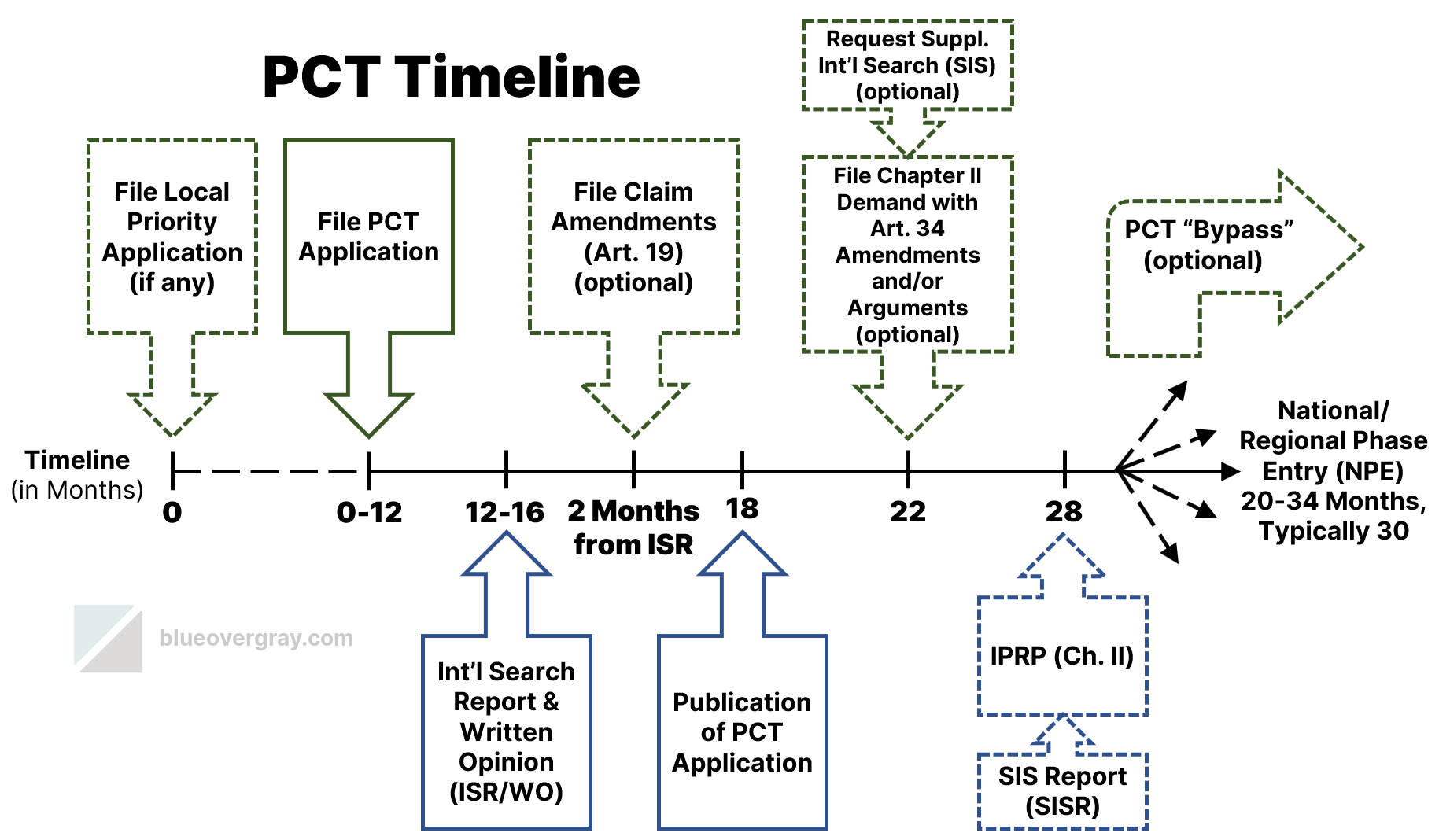
Typical timeline for PCT application up to national phase entry
In the timeline graphic above, applicant actions in the international phase are shown at the top and official actions are shown at the bottom. Items in dashed lines are optional, or are conditional upon optional action by the applicant. National phase entry, indicated at the right, requires applicant action in one or more individual countries or regions but is not shown in detail. There are other possible actions in PCT applications not specifically addressed here.
WIPO also provides a PCT time limit calculator that can be used to determine individual deadline dates for a given international application after initial filing.
The PCT system is not available for all types of patents in all participating countries. It is generally limited to utility (or invention) patents. Design patents (that is, for industrial/ornamental designs), plant patents (for certain asexually reproduced plants; plant-related inventions may still be eligible for a utility patent), and utility models (available in certain countries other than the USA) cannot be pursued directly through PCT applications.
International and National Phases
The PCT timeline has two major phases. The first is called the international phase. This runs from the time the PCT application is filed with a receiving office (RO) until the deadline to enter the national (or regional) phase. Then the national (or regional) phase begins with the filing of one or more national phase entries (NPEs) in individual participating national and/or regional patent offices. The international phase ends when the national phase begins.
The PCT application is called an international application and is assigned an international application number. The national (and regional) phase applications are assigned a local application number. But the national phase is just a different phase of the same PCT application and does not involve a priority claim between different applications.
Priority Claims
A PCT application can claim priority to one or more prior local (national or regional) patent application(s). Priority can be claimed to a prior application, including provisional applications, from any country that has joined the Paris Convention for the Protection of Industrial Property or is a member of the World Trade Organization (WTO). The deadline to file a PCT application is twelve (12) months from the earliest claimed priority date.
Of course, there is no need to file a local priority application. It is common to do so. But it is equally possible for a PCT application to be the first patent application filed, without any priority claim.
The PCT timeline graphic shown above uses month zero (0) as the earliest claimed priority date. This could be either the filing date of the earliest local priority application or the PCT international filing date if there is no priority claim. In either situation, many subsequent deadlines are calculated in relation to the earliest priority date.
Claim Amendments Under Article 19 (Optional)
An applicant can optionally file claim amendments under Article 19 of the PCT. The deadline for Article 19 claim amendments is either two (2) months from transmittal of the international search report (ISR) by the international search authority (ISA) or sixteen (16) months from the earliest priority date, whichever is later. However, late Article 19 claim amendments are still accepted if received by the International Bureau (IB) of WIPO before the technical preparations for international publication have been completed.
Article 19 amendments allow the applicant the option to amend the claims based on the results of the ISR for inclusion in the published PCT application. Article 19 also allows amendments to be made a single time during the international phase, as opposed to making separate amendments later on in individual countries/regions in the national phase. Applicants can still make amendments later on in the national phase, subject to local procedures.
Chapter II Demand and Article 34 Amendments and/or Arguments (Optional)
The designated international search authority (ISA) will issue an international search report (ISR) and written opinion (WO). These documents assess the patentability of the claims of the PCT application, but are notbinding on individual patent offices during the national phase. The applicant can optionally make a Chapter II demand and submit Article 34 amendments and/or arguments in response. Amendments filed this way can be to the claims, description (Specification), and/or drawings, so long as they are supported by the original disclosure and do not add new matter. Chapter II demands require payment of a preliminary examination fee. The deadline to file the demand is three (3) months from transmittal of the ISR/WO or twenty-two (22) months from the earliest priority date, whichever is later. Late filed demands are ignored.
If a Chapter II demand is made, the international preliminary examining authority (IPEA) issues an international preliminary report on patentability (IPRP) under Chapter II. The IPEA is the same patent office previously-designated as the ISA. The IPRP under Chapter II takes into account all amendments and/or arguments submitted by the applicant. The point of making a Chapter II demand is generally to try to convince the IPEA to issue an IPRP that is more favorable than the prior WO with regard to patentability. (What is a little confusing here is that the IPRP is also referred to as an international preliminary examination report [IPER]; and if no Chapter II demand is made, the original WO of the ISA later becomes the IPRP under Chapter I automatically.)
Chapter II demands are entirely optional. Applicants can still make amendments and arguments later on in the national phase in the absence of a demand in the international phase. But making demand may be helpful in some situations. Whether it is worthwhile often depends on the applicant’s national phase filing strategy. For instance, some participating states extend the national phase entry deadline if a Chapter II demand is filed. Also, some national patent offices are more likely than others to defer to the results of international preliminary examination. At times, it also matters which patent office served as the IPEA in terms of how much weight and deference national phase offices will give to its conclusions.
Supplementary International Search Request (Optional)
Applicants have the option to request an additional search by a different search authority. This is called a supplementary international search (SIS). These require payment of additional fees and are not common. The deadline for a SIS request is twenty-two (22) months from the earliest priority date. When requested, these result in a SIS report (SISR).
National Phase Entry
After filing a PCT international application, the only further applicant action typically affirmatively required is to enter the national (or regional) phase. This is when the applicant commits to the individual countries and/or regions in which enforceable patent protection will be pursued. If no national or regional phase entry is filed, the international application is abandoned in all designated states.
The deadline for national phase entry varies by country, from 20-34 months from the earliest priority date. Most countries—including the U.S., Canada, Mexico, Japan, and P.R. China—have a thirty-month (30-month) national phase entry deadline. A significant number of countries and regional patent offices—including the regional European Patent Organization (EPO), South Korea, and Australia—have a thirty-one-month (31-month) national phase entry deadline. Some countries also extend the NPE deadline if a Chapter II demand is made. The shortest NPE deadlines are 20 months for Luxembourg (without a Chapter II demand; though a longer period is available via the EPO with later validation in LU) and 21 months for Tanzania (without a Chapter II demand). It is important to verify deadlines for the particular countries/regions of interest.
Early national phase entry is possible. It is not necessary to wait until close to the deadline to enter the national phase. Late national phase entry is sometimes possible, if local requirements are met (such as being unintentional, for delayed entry into the USA).
National phase entries are generally limited to utility (invention) patents. Although design, plant, and utility model patents are available in some countries, they must be pursued separately from a PCT international application. For instance, a U.S. design or plant patent application can potentially claim priority to a pending international application, though that is not common.
An important benefit of the PCT system is that the national phase entry deadline occurs relatively late. The applicant gains up to about eighteen additional months (about thirty months total) to decide which countries/regions will be pursued compared to the usual twelve-month foreign priority period (under the Paris Convention). And the international preliminary examination provides some assessment of patentability. The additional time and information available at the NPE deadline can allow more informed decisions about where further patent filing fees are worthwhile.
PCT “Bypass” Applications (Optional)
In the U.S., it is possible to file a so-called PCT “bypass” application in addition to or instead of a regular national phase entry (NPE). A bypass application is filed like a continuing application (continuation, divisional, or continuation-in-part) that claims priority to a pending PCT international application that designates the USA. However, bypass applications are rather unique to the U.S. and other countries may not permit these sorts of filings. Bypass applications must be filed while the PCT international application is still pending. This makes the bypass filing deadline thirty-month (30-months) from the earliest priority date—the same as the U.S. NPE deadline.
Bypass applications are occasionally useful because there are procedural differences in how PCT national phase entries and regular (non-PCT NPE) U.S. applications are handled and examined. For instance, Track One prioritized examination is not available for PCT national phase entries. A bypass application also avoids the need to file all signed invention oaths/declarations before a request for continued examination (RCE). Also, filing a bypass divisional application in parallel with a regular NPE and splitting up the original PCT claims between them may cost less in official fees than filing only the NPE and paying extra claim fees.
Austen Zuege is an attorney at law and registered U.S. patent attorney in Minneapolis whose practice encompasses patents, trademarks, copyrights, domain name cybersquatting, IP agreements and licensing, freedom-to-operate studies, client counseling, and IP litigation. If you have patent, trademark, or other IP issues, he can help.
Prosecution history estoppel can arise when the patentee relinquishes subject matter during the prosecution of the patent—that is, during examination of a patent application at the U.S. Patent & Trademark Office (USPTO)—either by amendment or argument. A narrowing amendment made to satisfy any requirement for patentability (under 35 U.S.C. §§ 101-103, 112, 161, or 171) may give rise to an estoppel. When it applies, prosecution history estoppel will prevent a patentee from relying on the Doctrine of Equivalents to establish infringement based on the particular equivalents surrendered. A given claim limitation might be given only its literal scope (as properly construed) but no more. This policy allows competitors to rely on prosecution history estoppel to ensure that their own devices/processes will not be found to infringe by equivalence.
The Basic Rule
The Doctrine of Equivalents is an equitable doctrine created by courts long ago. It is premised on language’s inability to capture the essence of innovation, allowing some protection beyond the literal scope of a claim where the claimed invention and the accused product or process are equivalent. Its purpose is to “temper unsparing logic” that “would place the inventor at the mercy of verbalism and would be subordinating substance to form” and it evolved in response to situations where accused infringers attempted to “practice a fraud on a patent” by introducing “minor variations to conceal and shelter the piracy.” However, there is a tension between such concerns and the need for patents to put the public on notice of what a patent does and does not cover.
Prosecution history estoppel is about interpreting patent claims by reference to the history that led to their grant. It limits the patentee’s ability to establish infringement by equivalence to help provide certainty to competitors about the enforceable scope of a U.S. patent. Accordingly, the Doctrine of Equivalents is not available where prosecution history shows the inventor was able to capture equivalent differences in words but chose narrower language. The patentee cannot later recapture what was previously surrendered under the guise of the Doctrine of Equivalents. Where the original patent application once embraced the purported equivalent but the patentee narrowed his claims to obtain the patent or to protect its validity, the patentee cannot assert that he or she lacked the words to describe the subject matter in question.
Estoppel Can Arise Through Amendment or Argument
Prosecution history estoppel can arise two ways: (1) by making a narrowing amendment to the claim (amendment-based estoppel) or (2) by surrendering claim scope through argument to the patent examiner (argument-based estoppel). These two possibilities are discussed in turn.
How Amendment-Based Estoppel Can Arise
The first way that prosecution history estoppel can arise is by way of a narrowing amendment to a claim during prosecution. The question of what constitutes a narrowing amendment will depend on the context of a particular patent claim. But a classic example is adding words that narrow the limitations of a claim to avoid a prior art reference cited in a rejection in an office action. As another example, which is less intuitive, courts have said rewriting a dependent claim in independent form is an amendment adding a new claim limitation, which constitutes a narrowing amendment that may give rise to an estoppel.
How Argument-Based Estoppel Can Arise
Argument-based estoppel arises when the prosecution history evinces a “clear and unmistakable” surrender of subject matter. Argument-based estoppel most often arises when the patentee tries to convince a patent examiner that the claims of an application recite something different from the prior art. For instance, a patentee may have argued that a claim term has a meaning that is narrow enough to avoid a disclosure or teaching in a cited prior art reference. In such a situation, the patentee will likely be estopped from later asserting that the Doctrine of Equivalents encompasses what was previously argued to be outside the scope of the claimed invention. Such arguments are treated like an acknowledgement that the patentee knew the meaning of the claim language and deliberately chose narrower language in order to obtain a patent.
Scope of the Estoppel
Though prosecution history estoppel can bar a patentee from challenging a wide range of alleged equivalents used by competitors, its reach requires examination of the particular subject matter surrendered. Even where prosecution history estoppel applies, the scope of the estoppel is not always absolute. These inquiries differ somewhat between amendment-based estoppel and argument-based estoppel.
Scope of Amendment-Based Estoppel
The scope of amendment-based estoppel depends on the claim language at issue and the reason for the amendment. For instance, where the reason for the amendment was not related to avoiding the prior art, it does not necessarily preclude infringement by equivalents of that element. But an amendment to clarify the recitation of the claimed invention to satisfy definiteness requirements for patentability would give rise to an estoppel, even though there was no prior art reference prompting the change. Also, cancellation of a claim can give rise to estoppel with regard to any claim(s) that remain (or are added). However, the reason for an amendment is often not clear from the prosecution history.
When no explanation for an amendment is provided, there is a rebuttable presumption that the Doctrine of Equivalents is not available at all. When the purpose underlying a narrowing amendment cannot be determined—and hence the rationale for limiting the estoppel to surrender of only particular equivalents—it is presumed that the patentee surrendered all subject matter between the broader and the narrower language. But that presumption of amendment-based estoppel can be overcome for a particular equivalent when (1) the equivalent in question was unforeseeable at the time of the application, (2) rationale underlying the amendment bears no more than a tangential relation to the equivalent in question, or (3) the patentee could not reasonably be expected to have described the insubstantial substitute in question.
Scope of Argument-Based Estoppel
The scope of argument-based estoppel is based on the scope of particular arguments made during prosecution. Unlike amendment-based estoppel, there is no presumption-and-rebuttal approach. Rather, the question is how far argument-based estoppel applies in the first place, if at all. The question is whether there was a clear and unmistakable argument-based surrender of particular subject matter. Courts have said that simple arguments and explanations to the patent examiner do not surrender an entire field of equivalents. But any arguments can still surrender some equivalents, even if they do not surrender all possible equivalents. This is very context-dependent. The key to this inquiry is whether a competitor would reasonably believe that the patentee’s argument had surrendered the relevant subject matter.
However, courts have said that any clear assertions made during prosecution in support of patentability, whether or not those assertions were actually required to secure allowance of a claim, may still create an argument-based estoppel. Also, once an argument is made regarding a claim term that creates an estoppel, that estoppel will apply to that term in other claims in the patent too.
Prosecution Disclaimer
Prosecution disclaimer is a separate but related concept. Rather than relating to the availability of the Doctrine of Equivalents to establish infringement, prosecution disclaimer or disavowal can limit the proper construction of a claim’s literal scope. Thus, it may affect whether or not literal infringement is found—prior to any consideration of the Doctrine of Equivalents. For example, it can arise when a patentee makes arguments during prosecution about how the pending claims differ from the prior art. This is meant to prevent patentees from opportunistically taking different (and broader) positions in court when asserting infringement than when obtaining the patent in the first place. Statements made during the prosecution of family-related applications, even later-filed ones and foreign counterparts, may sometimes result in prosecution disclaimer as well.
Questions about prosecution disclaimer pertain to proper claim construction. Claim terms are presumed to carry their full and customary meaning unless the patentee unequivocally imparted a novel meaning to those terms either in the patent application itself (called acting as her own lexicographer) or expressly relinquished claim scope during prosecution. Just as with argument-based estoppel, prosecution disclaimers must be “clear and unmistakable” in order to limit claim scope. An ambiguous statement during prosecution will not limit a claim term’s ordinary meaning.
An important difference between prosecution disclaimer and prosecution history estoppel is when they are taken into account. Prosecution disclaimer is a matter of claim construction. That is something courts do as a first step in patent infringement analyses, without reference to the specific product or process accused of infringement. In contrast, the Doctrine of Equivalents is bound up with the subsequent comparison of the accused product or process to the asserted patent claims as properly construed. Prosecution history estoppel is a question of whether a patent owner is permitted to invoke the Doctrine of Equivalents in particular ways in the second part of infringement analysis, after claim construction. But if literal infringement is found—despite any prosecution disclaimer—there is no need to reach the Doctrine of Equivalents.
Austen Zuege is an attorney at law and registered U.S. patent attorney in Minneapolis whose practice encompasses patents, trademarks, copyrights, domain name cybersquatting, IP agreements and licensing, freedom-to-operate studies, client counseling, and IP litigation. If you have patent, trademark, or other IP issues, he can help.
At a most basic level, patent infringement in the U.S. involves making, using, selling, offering for sale, importing into the USA a patented invention without authorization. Although there are some additional grounds for infringement that may apply in some other circumstances. All grounds for infringement fall into two general categories: direct infringement and indirect infringement. These categories refer to who is being accused and whether they are directly responsible or instead indirectly or partly responsible.
There are multiple types of infringement under each category. These include literal or Doctrine of Equivalents infringement, and, for indirect infringement, active inducement of infringement, contributory infringement, and certain activities related to components for export from the USA. Each of these provisions, set forth in § 271 of the U.S. patent laws, is taken up further below.
Direct Infringement
Direct patent infringement means that an accused party is directly responsible for infringement a patent. Direct infringement requires that each and every limitation (or element) of at least one claim of an asserted patent is met either literally or under the Doctrine of Equivalents. If a limitation of a given patent claim is not present in the accused product or process, either literally or equivalently, then that claim is not infringed.
The sorts of things that can constitute direct infringement include the following:
making (that is, manufacturing) the patented invention in the USA (35 U.S.C. § 271(a))
submitting a new drug application for U.S. regulatory approval (Hatch-Waxman Act; 35 U.S.C. § 271(e))
importing into the USA, or offering to sell, selling, or using within the USA, a product which is made by a process patented in the USA, unless it is materially changed by subsequent processes or it becomes a trivial and nonessential component of another product (35 U.S.C. § 271(g))
violations of certain additional rights to exclude specific to plant patents (35 U.S.C. § 163)
Normally, any of these infringing acts requires a single entity to satisfy each and every limitation of a claim. However, it is also possible to have vicarious liability for infringement in situations where there are multiple entities involved in the use of a patented method/process or the making or using of a patented system/device. Vicarious liability is a type of direct infringement stemming from principles of agency law, and includes principal-agent relationships, contractual arrangements, and joint enterprises. But it does not include joint tortfeasor liability. Vicarious liability depends on control exercised by the entity accused of infringement over other involved entities. Control is what makes vicarious liability for direct infringement differ from indirect infringement (discussed below), with only the latter encompassing arms-length transactions and/or independent action.
There are two ways of finding infringement of a utility or design patent that differ in terms of how the accused product or process compares to the scope of the claim(s) of the asserted patent:
Literal Infringement
Infringement Under the Doctrine of Equivalents (also called infringement by equivalence)
For a plant patent, infringement requires proving:
asexual reproduction of the patented plant (by means other than from seeds, such as by the rooting of cuttings, by layering, budding, grafting, division, inarching, cloning, etc.)
The concepts of literal infringement and infringement under the Doctrine of Equivalents are not usually invoked for patent patents, due to infringement being narrowly applicable to the progeny of a patented plant through asexual reproduction that involves physical taking or appropriation of the patented plant’s biological material.
Literal Infringement
Literal infringement means that the accused product or process falls within the scope of the asserted claim(s) as construed by a court. Under U.S. law, infringement analysis is a two-step process. It involves, first, construing the claims to ascertain their meaning to a person of ordinary skill in the art and to resolve any ambiguities or disputes over that meaning, and, second, comparing the accused product/process to the properly construed claim(s). Literal infringement is present when the accused infringer meets each and every limitation (or element) of an asserted patent claim exactly, as properly construed. Any deviation from a claim limitation (as properly construed) precludes a finding of literal infringement.
Infringement Under the Doctrine of Equivalents
Under the Doctrine of Equivalents, a product or process that does not literally infringe upon the express terms of a patent claim may nonetheless still be found to infringe if there is “equivalence” between the elements of the accused product or process and claimed elements of the patented invention. This type of infringement arises when the accused product or process is outside the literal scope of at least one limitation of an asserted claim, as properly construed. Patentees rely on the Doctrine of Equivalents under the second step of the infringement analysis, if at all, only if literal infringement cannot be established. Otherwise, the Doctrine of Equivalents can apply to the same set of activities as for literal infringement.
This is an equitable doctrine meant to “temper unsparing logic” that “would place the inventor at the mercy of verbalism and would be subordinating substance to form.” It evolved in response to situations where accused infringers attempted to “practice a fraud on a patent” by introducing “minor variations to conceal and shelter the piracy.” Of course, the doctrine is in tension with the policy requiring that claims put the public on notice of a patent’s scope. This is a reason the Doctrine of Equivalents is not meant to be routinely invoked and is not applied broadly. In other words, this type of infringement is a limited exception to the general rule that patent claims must reasonably put others on notice of the outermost boundaries of what constitutes infringement. Put another way, it allows a limited form of “central” claim enforcement in a regime of “peripheral” claiming.
The Doctrine of Equivalents is applied individual claim limitations rather than to the claimed invention as a whole. To find infringement, each claim limitation (or element) must be found either literally or equivalently in the elements of accused product/process. This is called the “all elements” rule. The question of equivalence is inapplicable if a claim limitation is totally missing from an accused device. The Doctrine of Equivalents cannot be used to re-draft claims and effectively eliminate limitations entirely. Though this inquiry always revolves around what differences can reasonably be considered equivalent. An undue expansion of a patent’s claim(s) is not permitted. After-arising technology can potentially be encompassed by the Doctrine of Equivalents (unlike for means-plus-function equivalents).
There are two approaches to assessing equivalents: the “insubstantial differences” test and the “function-way-result” test. The function-way-result test (also called the “triple identity” test) says that equivalence may be present for a given element if the accused product/process performs substantially the same function in substantially the same way with substantially the same result. This is not the only way to assess whether differences are insubstantial, but it is particularly useful for certain types of inventions such as mechanical devices. For biochemical inventions, however, looking at substantial differences may sometimes be more appropriate than the function-way-results test.
There are numerous limits on the Doctrine of Equivalents, which are really beyond this basic introduction. But an extremely important limit on the availability of the Doctrine of Equivalents is prosecution history estoppel. Things that the patentee did or said when obtaining the asserted patent might limit the patentee’s ability to later rely on the Doctrine of Equivalents. So the Doctrine of Equivalents is not always or automatically available.
Indirect Infringement
Indirect patent infringement means that an accused party is causing or enabling someone else to infringe. It can apply when an accused infringer meets some but not all of the limitations (or elements) of an asserted patent claim. It includes three types of infringement, which differ in terms of what the accused indirect infringer is doing:
Supplying Component for Export for Combination Outside the USA (35 U.S.C. § 271(f))
Generally speaking, there are additional requirements that must be satisfied to establish indirect infringement that are not required for direct infringement. Those additional requirements vary depending on what type of indirect infringement is asserted.
Also, relevant limitations of asserted claim(s) can be assessed under either their literal scope or under the Doctrine of Equivalents, if available—see discussions above of literal and Doctrine of Equivalents infringement for direct infringement. This is really to say that the Doctrine of Equivalents may still apply to indirect infringement scenarios.
Active Inducement of Infringement
Actively inducing someone else to infringe a patent constitutes inducement of infringement. Specifically, “[w]hoever actively induces infringement of a patent shall be liable as an infringer.” (35 U.S.C. § 271(b)). This is a form of vicarious liability. Active inducement requires taking an affirmative steps to encourage infringement by another entity, as well as knowledge that the encouraged acts infringe the asserted patent. A key component of inducement is that it requires there be at least one direct infringer. But the difference here is that instead of suing the direct infringer, a different entity is sued for inducement.
Inducement commonly arises in situations involving claims to a method of using a product. Rather than sue the end user, which may be a potential customer, the patentee instead sues a competitor making and selling products used by others to (directly) perform and infringe the asserted method claim(s). It also sometimes arises where a corporate officer or owner induces his or her company to infringe, making that individual personally liable for infringement.
Contributory Infringement
Contributory infringement arises when selling, offering to sell, or importing components that are specially made or adapted for use to infringe a patent. However, contributory infringement excludes activities involving a staple article or commodity of commerce that is suitable for substantial noninfringing use. A “substantial noninfringing use” is any use that is not unusual, far-fetched, illusory, impractical, occasional, aberrant, or experimental. So there is normally no liability for selling general-purpose commodities, even if they could be used in making or using a patented invention.
“(c) Whoever offers to sell or sells within the United States or imports into the United States a component of a patented machine, manufacture, combination or composition, or a material or apparatus for use in practicing a patented process, constituting a material part of the invention, knowing the same to be especially made or especially adapted for use in an infringement of such patent, and not a staple article or commodity of commerce suitable for substantial noninfringing use, shall be liable as a contributory infringer.”
In order for contributory infringement to be present, the infringer must know that the combination for which his component was especially designed was both patented and infringing. This knowledge requirement differentiates contributory infringement from direct infringement, which does not require any such knowledge of the patent or infringement (except to enhance damages).
Contributory infringement is important for situations involving the sale of repair or replacement parts for use in or with patented products or methods.
Supplying Component for Export for Combination Outside the USA
Section 271(f) of the patent laws creates two grounds for infringement involving activities in the USA relating to products made in a foreign country. They arise when components of a patented invention are supplied for export from the USA. These grounds for infringement are similar to yet distinct from active inducement and contributory infringement, discussed above. But these provisions do not require that the equivalent of “foreign” direct infringement occur. That is, the actual combination need not actual occur. However, these provisions apply exclusively to apparatus claims, and are not available for method/process claims. They also do not apply to activities that occur entirely outside the USA. Also, § 271(f)(1) has a quantitative requirement about the number of components involved and it does not apply to only a single component.
“(f)
(1) Whoever without authority supplies or causes to be supplied in or from the United States all or a substantial portion of the components of a patented invention, where such components are uncombined in whole or in part, in such manner as to actively induce the combination of such components outside of the United States in a manner that would infringe the patent if such combination occurred within the United States, shall be liable as an infringer.
(2) Whoever without authority supplies or causes to be supplied in or from the United States any component of a patented invention that is especially made or especially adapted for use in the invention and not a staple article or commodity of commerce suitable for substantial noninfringing use, where such component is uncombined in whole or in part, knowing that such component is so made or adapted and intending that such component will be combined outside of the United States in a manner that would infringe the patent if such combination occurred within the United States, shall be liable as an infringer.”
The grounds for infringement under § 271(f) are somewhat rarely invoked. This is largely because manufacturing costs are often higher in the USA than abroad. As a result, courts have not extensively clarified the scope and proper application of these provisions. But suffice it to say they may apply in situations where components are being produced and/or sold in the USA for export.
Austen Zuege is an attorney at law and registered U.S. patent attorney in Minneapolis whose practice encompasses patents, trademarks, copyrights, domain name cybersquatting, IP agreements and licensing, freedom-to-operate studies, client counseling, and IP litigation. If you have patent, trademark, or other IP issues, he can help.
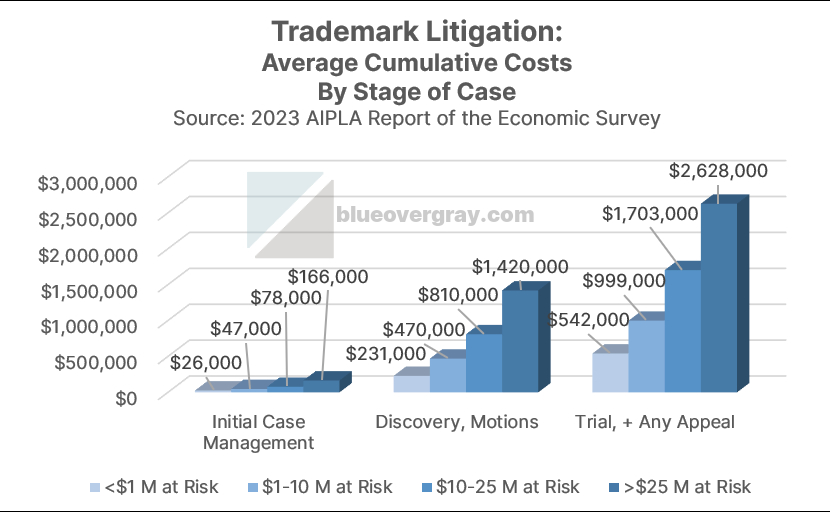
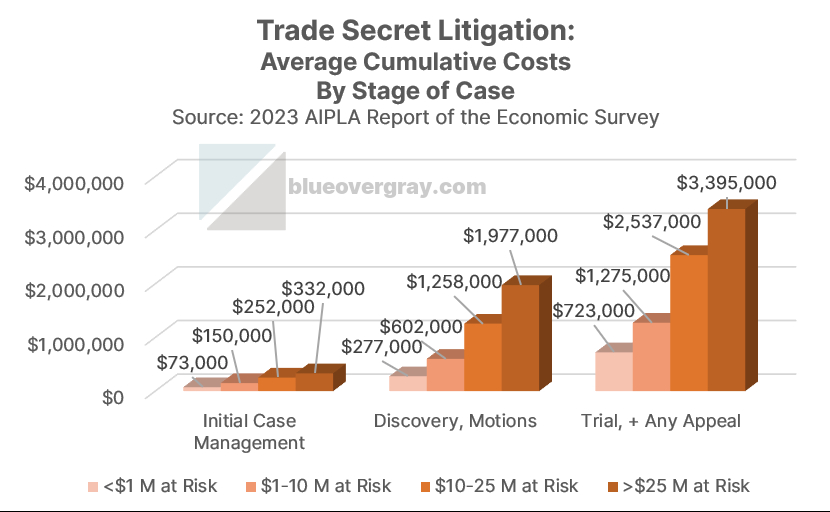
Intellectual property (IP) litigation tends to be relatively expensive compared to other types of lawsuits. There are many reasons for that. Though the complexity of the legal issues involved and a tendency for extensive pre-trial discovery and use of expert witnesses contribute to the total costs.
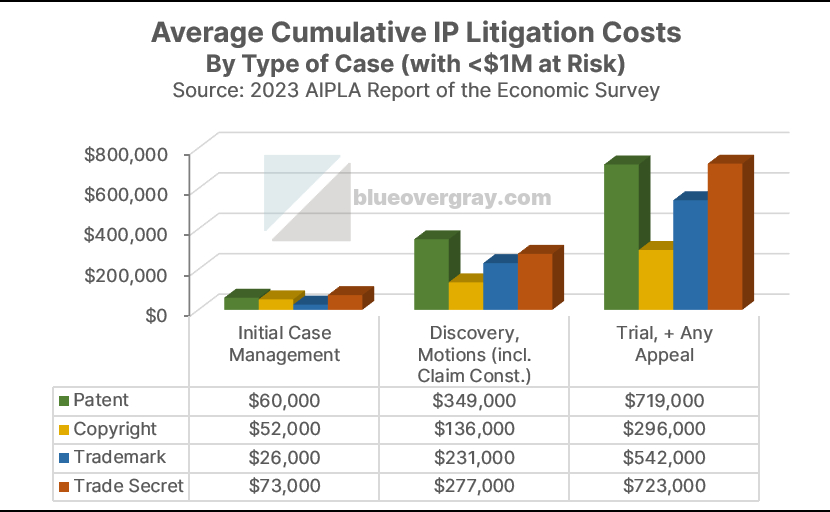
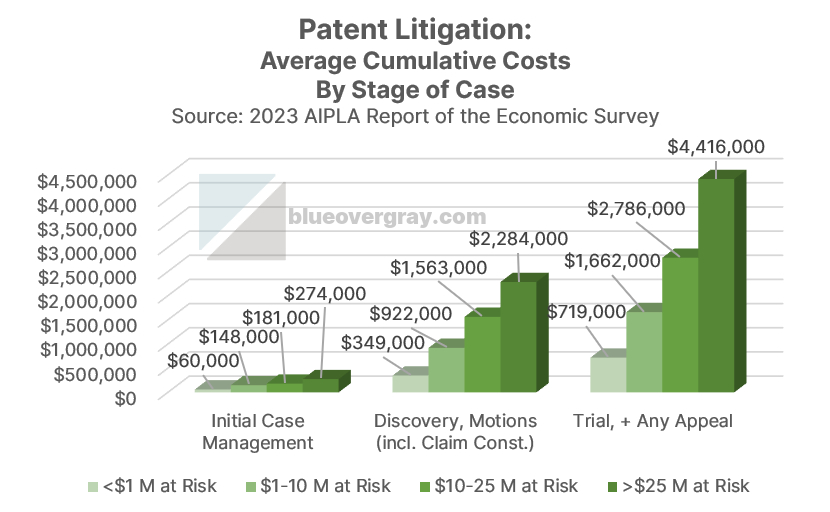
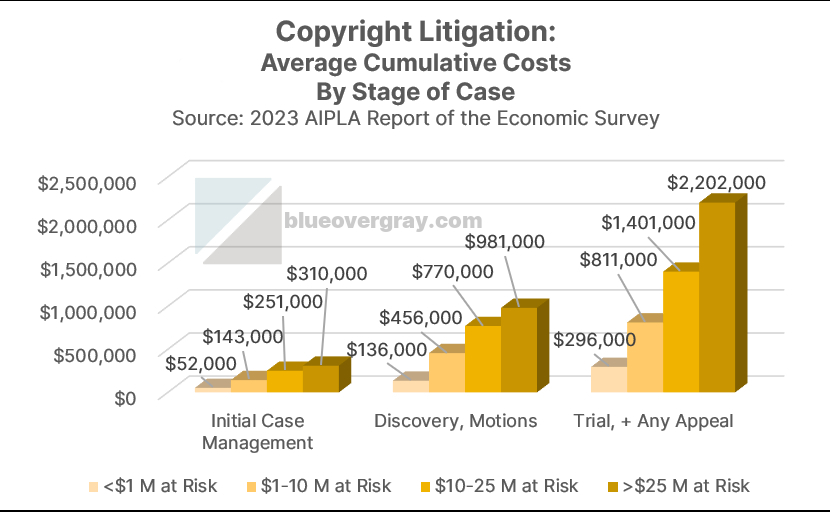
Below are graphs showing average costs through various stages of a an infringement or misappropriation lawsuit in the U.S. A summary graph compares average costs for “small” patent, copyright, trademark, and trade secret cases with less than $1,000,000 at risk. There are also individual graphs for patent, copyright, trademark, and trade secret cases with different amounts at risk, that is, with different amounts of potential damages for infringement or misappropriation (in U.S. dollars). All data comes from the 2023 AIPLA Report of the Economic Survey.
Comparison of Average “Small” IP Lawsuit Costs by Type of Case and Stage
Austen Zuege is an attorney at law and registered U.S. patent attorney in Minneapolis whose practice encompasses patents, trademarks, copyrights, domain name cybersquatting, IP agreements and licensing, freedom-to-operate studies, client counseling, and IP litigation. If you have patent, trademark, or other IP issues, he can help.