Categories
Q&A Trademarks

How Should a Trademark Search Be Conducted?

What should a trademark search involve? How should a trademark search be conducted? These are questions about the scope and format of a trademark search. There are many different ways of performing trademark searches that vary in scope and thoroughness. Not all searches are equal. The right approach will depend on a number of factors including the purpose of the search and the type of legal questions the search is meant to address. The following is an overview of basic considerations about how to structure a trademark search to meet your needs.

Different Types of Searches

Sometimes trademark searches are grouped into different levels, with different pricing. A basic search is sometimes called a “knockout” search. These are usually the cheapest option. Names like “comprehensive” are applied to other types of searches that are more thorough (and more expensive). There are also special searches for various specific purposes, such as to look for evidence of relatedness of goods and services. But what differs between these different searches in terms of what you get? And which one is the right choice for your circumstances?

Knockout Searches

A knockout or preliminary search is usually the most basic and most limited in scope. It is typically limited to searching only registrations and pending applications in a particular jurisdiction. This means it will not capture unregistered uses of similar trademarks that may exist.

Also, a knockout search may be limited in terms of capturing variations. Trademarks do not need to be identical to create problems under the likelihood of confusion standard. The exact scope of knockout searches can vary. But often they will provide little or no identification of alternate spellings, phonetic equivalents, translations, distinct terms with a similar meaning, or the like. Yet prior trademarks that are not identical can still create a likelihood of confusion in some situations.

If a knockout search is all your budget permits, it may be better than nothing. But often a knockout search is often too limited to provide a lot of value. For example, for a trademark clearance or freedom-to-operate in the United States where unregistered “common law” trademark rights can exist, a knockout search is generally inadequate. And even for merely preliminary purposes some “bargain” searches may fall short. Quite frankly, cheap searches are not always reliable.

More Comprehensive Searches

A more comprehensive or full trademark search is usually just what the name implies. It is a broad search meant to capture as much as is feasible within a reasonable budget. More comprehensive searches will typically assess any unregistered prior uses. These searches also usually devote much more effort toward searching for alternate spellings, phonetic equivalents, and different words with similar meaning. But beyond those typical parameters, the exact scope of these searches can still vary. There is a continuum of effort involved.

For example, sometimes, but not always, they will address registrations in U.S. states, territories, and districts too. For marks used only locally, and not in interstate commerce, such a state or similar registration might be the only type available. Searching all such state-level registrations can add significant extra expense to a search and therefore is frequently omitted.

Also, whether foreign words are searched will also vary considerably. There are many languages and whether wording of a proposed mark would be considered relevant to one with a similar meaning in another langue is very context-dependent. It can matter if the other language is commonly spoken in a relevant area. For these reasons, translations will usually be considered like separate searches and excluded from even fairly comprehensive searches.

Special Searches

There can also be other types of trademark searches meant to address very particular questions. For instance, there can be situations during the examination of a trademark application or in connection with a lawsuit in which certain trademark searches are useful. These can include searches for evidence of relatedness of goods and services, by looking for usage of a single brand with different but “related” goods/services. Also, trademark-related searches might be performed to identify evidence of genericness or of descriptive meaning of the the words of a given mark.

Geographic Scope

Every trademark search should consider the particular jurisdictions of interest. That is because trademark rights are territorial. They exist only in in particular countries, states, or blocs (like the European Union). For example, there might be pre-existing trademark rights in one country but not another. A search for trademarks in one country will tell you little or nothing about trademark rights in other countries.

If new branding will be used in multiple countries or geographic regions, a trademark search (or series of searches) should encompass each and every one of them. Even if a trademark will not be used in other regions immediately, if expansion to them is likely or merely possible in the future it may help to search those countries too. This can allow evaluation of possibilities for later geographic expansion. This avoids being boxed-in and finding later expansion stymied.

For very substantial brands, with large advertising campaigns planned, it may also be worthwhile to search other jurisdictions to identify potential priority claims. This is because an international treaty may permit an application to be filed in a country of interest that claims priority to an application filed in another country up to six months earlier. In other words, this means searching in countries beyond those you plan to use your mark in. Although this sort of step is often skipped due to the effort and cost and the relative infrequency of such priority claims causing problems.

The type or scope of searching that fits your needs will depend on the nature of the proposed use of a trademark and the particular legal questions you want to address. And your budget. But bear in mind that a search alone tells you little or nothing unless the search results are analyzed by knowledgeable trademark counsel. It is all too easy to misunderstand the significant of bare trademark search results if unfamiliar with trademark law. You need a legal opinion too. Running a few queries yourself in a trademark database and (supposedly) getting “no results” may only provide false confidence.

Another way to think about all this is to ask, “How difficult would it be to later re-brand later?” If the answer is “difficult”, then a broader and more thorough search and analysis is worthwhile. When you are not well positioned to pay legal fees to defend yourself against infringement allegations, or just the thought of having to do this later seems unpleasant, then a search is one way to try to reduce those risks upfront. These things point to doing more than a cursory knockout search. Yet a slogan or tagline might be easily dropped or changed in some situations, unlike a primary brand.

More limited searches are better suited to low-stakes situations. For instance, when you are only concerned with registrability in the short term, such as for a planned intent-to-use (ITU) trademark application, then a knockout search may be minimally adequate. During examination of new U.S. federal trademark applications, the U.S. Patent & Trademark Office (USPTO) only looks at prior federal registrations and pending applications. They do not search for unregistered “known marks”. So a knockout search is similar in scope to searching done by a trademark examiner. But a knockout search will usually not provide a very good picture of all possible oppositions or cancellations sought by others against your desired trademark registration.

Have a Backup or Alternate Mark In Mind

It is quite common for a trademark search to reveal a potential problem with a proposed mark. For that reason, it is often helpful to conduct searching against a list of multiple candidate trademarks. These could be ranked in preferential order. Having a list of multiple marks searched and then legally reviewed in parallel or in preferential sequence increases the chances that at least one of them will be available and registrable. This can be especially beneficial when clearing a mark planned for use in many different countries or regions.

Of course, working from a list of multiple candidate trademarks makes the most sense before you have committed to certain branding. That can be challenging for many businesses. There is a tendency to grow attached to desired branding. But the pain of giving up on a favorite only gets worse if you have to re-brand later because of a problem.

Caution: No Search is Perfect

No matter how thorough, no search can eliminate all risk when selecting and adopting a trademark. Searching is always imperfect and can only serve to minimize risks. Trademark rights in the United States arise primarily from use and not mere registration. So it is possible that someone is using the proposed mark (or a similar one) in connection with the same or similar goods and/or services, but that use may not be detected in the search. That could be because the prior user did not seek registration or a prior mark was not listed in any of the resources or databases that the searcher used.

Also, when it comes to the analysis of search results, there can be differences of opinion. A prior user or registrant noted in this search may object to use or registrations of a proposed mark. Such objections may be questionable or even baseless at times. That is sometimes called trademark bullying. Or there may be facts that influence the ultimate outcome of a dispute that the searcher or attorney was not aware of.

The main takeaway is that just because a search does not identify any problems does not mean that an infringement allegation or refusal of registration is impossible. The right search and a competent legal analysis can still be quite useful and valuable.

Photo of Austen Zuege

Austen Zuege is an attorney at law and registered U.S. patent attorney in Minneapolis whose practice encompasses patents, trademarks, copyrights, domain name cybersquatting, IP agreements and licensing, freedom-to-operate studies, client counseling, and IP litigation. If you have patent, trademark, or other IP issues, he can help.


Categories
Q&A Trademarks

Do I Need a Trademark Search?

When adopting branding, such as a brand name or logo, people sometimes wonder, “Do I need to conduct a trademark search?” Or, “Is this trademark available?” These questions can arise when considering filing a new trademark application. Or they can come up when adopting branding for new products or services being offered for sale. In either context, this question should be considered at some level. What follows is more detailed information about whether and when a trademark search is worthwhile. Another article covers how to structure a trademark search.

What a Trademark Search Can Tell You

Some brand names and logos are already taken by others. In fact, it is quite common that when you have a “great” branding idea someone else has already had the same idea or a similar one. A trademark search can help address either or both of the following questions:

  • Will proposed branding create a significant risk of infringing someone else’s existing trademark?
  • Will a given proposed trademark be registrable?

The first question is about trademark clearance or freedom-to-operate. It is about assess risk and trying to avoid infringement problems and disputes. The second question is about whether a given jurisdiction is likely to grant you a trademark registration. It is more about how protectable a proposed mark appears to be. Put another way, the second question can inform you about the scope of exclusivity potentially available under the proposed mark. But both questions are about trademark availability.

A single trademark search in a given jurisdiction can generally be used to analyze both of these questions. So one search should permit both legal questions to be addressed. But the scope and thoroughness of a search can vary.

What a Trademark Search Won’t Tell You

In the strict sense, simply searching for trademarks tells you very little. It will only produce a list of existing marks. But which of those matter? Which ones are distinguishable? Which ones are close enough to present problems? Also, simply obtaining a list of prior trademarks will not tell you whether a proposed new mark is distinctive enough to serve as a trademark. And a search alone will not address other strategic considerations involved in trying to register a particular trademark.

After obtaining search results, it is necessary to further analyze whatever comes up in a search from a legal perspective. Anyone who does not understand trademark law will struggle to properly interpret what is or is not a problem when it comes to infringement risk and obstacles to registration. Self-serving bias is a common issue too. When you have a great branding idea, you might be biased against the notion that someone else already has a trademark that presents an obstacle to your business plans. This can turn into a matter of unreasonably splitting hairs over illusory differences. Or it can lead to incorrectly disregarding inconvenient or disappointing search results.

It helps to have a knowledgeable and independent expert analyze search results and provide guidance about registrability and/or any infringement risk. This kind of legal analysis goes beyond searching alone.

Which Region or Regions?

Trademark searches should be considered for each relevant region. That is because trademark rights are territorial. They exist only in particular jurisdictions, that is, in particular countries, states, or blocs (like the European Union). For example, there might be pre-existing trademark rights in one country but not another. If new branding will be used in multiple countries, a trademark search (or series of searches) should ideally encompass all of them.

Is a Search Legally Required?

In the United States, it is not required to perform a trademark search before applying to register a mark. So, it is possible to proceed without a search and take your chances. But it is a gamble.

But, on the other hand, investing considerable effort and resources into developing and advertising a brand only to find out later that it cannot be protected may lead to crushing disappointment. And it may result in wasted time and money. Having to rebrand later on after a problem arises is usually far more expensive than the cost of an initial search and analysis. On top of that, legal liability and even merely a cloud of uncertainty can have a terrible impact on a business, from disruption of daily operations to decreased valuation.

An early trademark search encourages adoption of a non-infringing and registrable mark from the start. The cost and burden to switch marks or re-brand generally increases over time. So even if a search is not mandated by law, obtaining one along with a legal opinion still offers pragmatic benefits. Those steps can potentially avoid a lot of later headaches.

Didn’t I Already Take Care of This?

You still want a trademark search despite having registered a company or assumed name with a local government. The same goes for having already registered a domain name containing your trademark. The fact is that practically no screening is performed by the government or a domain registrar. They only care about such names having the slightest differences. Corporate filings and domain name registrations are accepted when there are only minor differences in terms of punctuation or a single different letter. That is not enough to avoid trademark problems. Trademark confusion and infringement (and/or cybersquatting) is still possible in those situations.

Small businesses often mistakenly believe that corporate and domain name filings insulate them from legal problems like trademark infringement. But they don’t.

When is a Search Needed?

In terms of timing, a trademark search should be performed before any new brand is adopted and used. In other words, the ideal time for a search is before you commit to a particular trademark and before you start actually using it. But searches can still be worthwhile later on. For instance, as usage changes to encompass different goods or services, or expands geographically, new issues might arise that call for a new or further trademark search. Special types of searches may also be useful during examination of a trademark application or in connection with a contentious proceeding.

Further, a trademark search is just snapshot at a given moment. Use of similar marks by others is constantly changing. Prior registrations are abandoned or cancelled, commercial usage changes, consumer perceptions evolve, and new brands are adopted by others. This means that trademark search results can go stale and lose relevance as time passes. Ideally, a trademark search should be performed close to when business and marketing decisions are made about the mark being searched. Old search results may not be reliable for a legal review much later in time.

Photo of Austen Zuege

Austen Zuege is an attorney at law and registered U.S. patent attorney in Minneapolis whose practice encompasses patents, trademarks, copyrights, domain name cybersquatting, IP agreements and licensing, freedom-to-operate studies, client counseling, and IP litigation. If you have patent, trademark, or other IP issues, he can help.
Categories
Patents Q&A

What Exclusive Rights Does a Patent Provide?

What sort of legal rights does a patent provide to a patent holder? This article explains what exclusive rights arise from patents. It also addresses a common misconception about the scope of patent rights.

The Right to Exclude

In the simplest terms, patent rights are about the right to exclude others. A patent provides a limited monopoly over an invention in a particular jurisdiction. The scope of rights in any given patent will depend on the scope of the claims in that patent, which define the specific invention that is patented, as well as scope of monopoly rights granted under the patent laws of the relevant jurisdiction. Patent rights are territorial. They provide enforceable rights only in a particular country (or regional group of countries). Patent rights also only last for a limited period of time, called term. At the end of their term they expire and the patented invention can then be freely practiced by others.

Under U.S. patent law, a patent gives the holder exclusive rights to make, use, offer to sell, sell, or import the patented invention. Put another way, anyone who does any of these things with the patented invention—or some other related but more indirect things—can be liable as an infringer.

The exclusive rights provided by patents can be significant. In the absence of a patent (or other intellectual property right, like copyright), a product or service that is being sold or offered commercially can generally be copied by others. But patents are only awarded for inventions that meet the requirements for patentability.

Not a Right to Practice an Invention

A common misconception about patent rights is assuming that having a patent provides an affirmative right to practice the patented invention. This is actually not true. A patent provides only a right to exclude others from practicing the claimed invention. But it is possible that someone else has a prior patent that also covers some aspect of the invention. In that case, the earlier patent can be called a blocking patent. A later invention might still be patentable as an improvement. But that later patent can be called a subordinate patent. That is because practicing it requires rights to the blocking patent during the blocking patent’s term.

Take the following simple example. A first person invents and patents a bucket. Later, another person invents and patents an improved bucket with a handle. The addition of the handle made the second invention patentable. And the later patent about the handle prevents the first inventor from adding a handle to buckets. But the earlier patent on the bucket itself prevents the second inventor from selling buckets with handles during the term of the earlier inventor’s blocking patent without a license.

Of course, it is also possible that there are laws completely unrelated to patents that prohibit selling or using a patented invention. For instance, local health & safety laws, building codes, or the like might prohibit certain things that would be necessary to sell or use an invention. Having a patent does not exempt the patentee from complying with those other laws.

Photo of Austen Zuege

Austen Zuege is an attorney at law and registered U.S. patent attorney in Minneapolis whose practice encompasses patents, trademarks, copyrights, domain name cybersquatting, IP agreements and licensing, freedom-to-operate studies, client counseling, and IP litigation. If you have patent, trademark, or other IP issues, he can help.
Categories
Patents Q&A Trademarks

What Is the Federal Circuit?

In the field of U.S. intellectual property (IP) law, there are often references to the Federal Circuit. What is the Federal Circuit? This brief article will explain it.

Overview

The United States Court of Appeals for the Federal Circuit, or “Federal Circuit” for short, is a U.S. Federal appeals court. It hears cases appealed from various places including U.S. federal district courts and certain Federal agencies including the U.S. Patent & Trademark Office (USPTO) and the International Trade Commission (ITC). It was created in 1982. It replaced and merged the prior U.S. Court of Customs and Patent Appeals and the appellate division of the U.S. Court of Claims, which no longer exist.

Jurisdiction

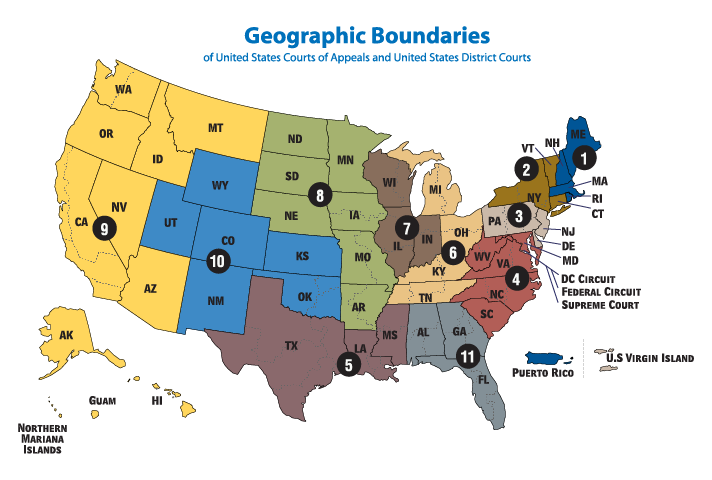
What makes the Federal Circuit rather unique is that it has exclusive subject matter jurisdiction for certain types of cases. (28 U.S.C. § 1295). In general, appeals in Federal cases are made to regional circuit courts. That is, federal appeals courts are mostly divided into geographic “circuits”. They hear appeals from lower (district) courts within their respective geographic areas. But, instead, the Federal Circuit hears appeals from any district court in the country relating to patents and certain other matters, as well as appeals from certain executive branch agencies.

Map of geographic boundaries of U.S. courts of appeals (and U.S. district courts)
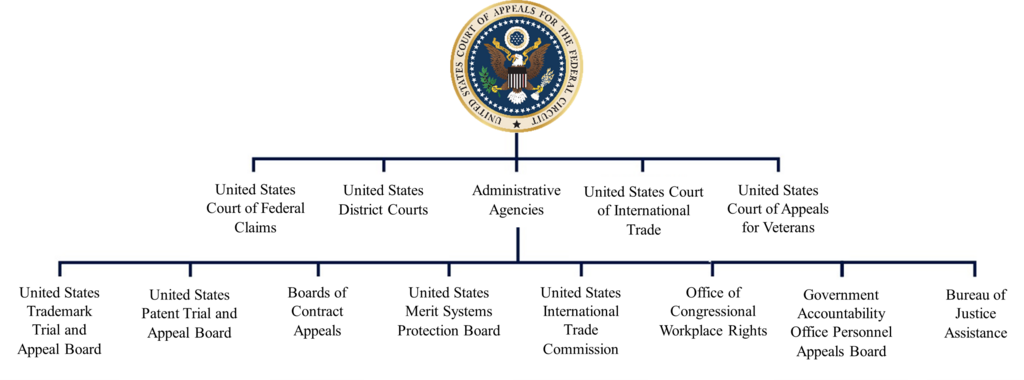
tree graphic illustrating Federal Circuit jurisdiction

In particular, the Federal Circuit has exclusive appellate jurisdiction over all U.S. federal cases involving patents, plant variety protection, trademark registrations, government contracts, veterans’ benefits, public safety officers’ benefits, federal employees’ benefits, and various other types of cases. Appeals involving Trademark Trial & Appeal Board (TTAB) and Patent Trial & Appeal Board (PTAB) decisions and patent and trademark prosecution (that is, cases related to the examination and granting of patents and trademark registrations) all go to the Federal Circuit. There are some exceptions, however. Cases involving assignments of patents may go to a regional circuit court instead. Trademark infringement matters are appealed from district courts to regional circuits, not to the Federal Circuit.

Conclusion

Because of the number of patent and trademark cases it hears, and its exclusive jurisdiction over cases involving U.S. patent laws, the Federal Circuit is important to know about in order to understand IP law in the United States. Federal Circuit opinions and orders (i.e., decisions in individual cases) can be found here, or via proprietary case reporter publications and databases.

Photo of Austen Zuege

Austen Zuege is an attorney at law and registered U.S. patent attorney in Minneapolis whose practice encompasses patents, trademarks, copyrights, domain name cybersquatting, IP agreements and licensing, freedom-to-operate studies, client counseling, and IP litigation. If you have patent, trademark, or other IP issues, he can help.

Categories
Patents Q&A

What Are Claims in a Patent?

Patents and patent applications typically have one or more “claims”. But what are claims? What is the significance of claims in patent law? This article offers a brief explanation of what they are and why they matter. It also explains some common misunderstandings and misconceptions about patent claims that can lead to great confusion.

Purpose of Claims

Patents provide exclusive rights in the form of a limited monopoly to an invention. Claims define the scope of exclusive legal rights in a granted patent or, in the case of a patent application, the scope of exclusive rights being sought. In other words, when thinking of patents as being premised on a quid pro quo, claims define the boundaries of the exclusive rights granted by a government to the patentee in exchange for disclosing an invention.

A common way to explain patent rights is to analogize them to real property (that is, land ownership). The claims are what establish the boundaries or metes-and-bounds of legal rights to a given patented invention. So claims are a bit like lot lines that establish the perimeter of a plot of land. Anything falling within the scope of a claim is protected. Just like the area within lot line boundaries belongs to the landowner.

Consider this simple guideline for granted patents: anything claimed is patented, and anything not claimed is not patented. In that sense, claims put others on notice of the scope of exclusive rights held by a patentee. And, when a new patent application is filed, the claims are the main focus of examination to determine if the invention (as claimed) is patentable. A patent is only being sought for what the claims of a given application recite.

Under U.S. patent law, claims are considered a part of the “specification” of a patent application. The basic requirements for claims are set forth in Section 112 of those patent statutes:

“The specification shall conclude with one or more claims particularly pointing out and distinctly claiming the subject matter which the inventor or a joint inventor regards as the invention.”

35 U.S.C. § 112(b)

When the U.S. patent laws set out what constitutes infringement of a “patented invention” (35 U.S.C. § 271). This is a reference to the claims. That is because the claims are what define the scope of the patented invention.

However, patent laws may differ between countries. For instance, the USA follows what is called peripheral claiming. Peripheral claims set forth the outermost boundaries of the exclusive rights with reasonable clarity, and anything outside the claims is generally not protected (with a rare exception under the doctrine of equivalents). But some other countries follow central claiming instead. Under central claiming regimes, the claims set out a basic inventive concept and the exclusive patent rights encompass an area that might extend beyond the literal scope of the claim language based upon the inventor(s)’s contribution over the prior art (as later determined by a court). Peripheral claiming makes the scope of rights more certain prior to an infringement lawsuit.

Content

What claims say and how they say it varies. They are unique to each application or patent. They are also written by patent applications, who have considerable discretion over what they recite and how they are formulated. Claims are meant to define inventions, so they necessarily vary to reflect the particular subject matter of a given invention. But any given claim might define an invention broadly or narrowly in scope, relatively speaking.

In order for a patent application to be found patentable, its claims have to meet the requirements for patentability. Among other things, this means that the claims must distinguish the invention over the prior art. Accordingly, claims of a given application may try to distinguish the prior art by reciting elements (also called limitations) that go beyond what was already known.

Claims can be—and often are—amended, and may between an original application, a pre-grant published application, and/or a later-granted patent. Claims might also be canceled/deleted or new claims added during examination (which is also called “prosecution”). There are even procedures to amend or correct claims after a patent has issued. This means that the substantive content of the claims can change over time. Sometimes this means that a given claim is narrowed by amendment to establish patentability. This can give rise to prosecution history estoppel.

The interpretation or construction of terms in a patent claim is very important. For instance, certain terms of art may have special legal or technical meaning. The way claims are interpreted can vary greatly between different jurisdictions.

Format

The format in which claims are written follow some general guidelines, even if their substantive content varies. For instance, they always appear at the very end of U.S. patents. They are each written as a single sentence. Parts of a claim may start on separate lines with special indenting to highlight distinct clauses. Although any given clause might contain multiple discrete limitations or elements. It is common for claims to use words like “wherein” and “comprising” that are not often used in everyday speech.

Means-plus-function (or step-plus-function) limitations are also a special type of claiming format permitted in the USA (35 U.S.C. § 112(f)). These limitations are interpreted to cover corresponding structures, materials, or acts disclosed elsewhere in the patent or application (and their known equivalents). Understanding when means-plus-function claiming is invoked or applies, and how to properly interpret the scope of that limitation, is sometimes difficult. But one rule is clear. There can be no “single means” claims, because a claim that contains only a single limitation in means-plus-function format would be an impermissible central claim rather than a peripheral claim.

A patent may have only one, a few, or very many claims. Typically, each claim is separately numbered. Some claims may refer back to prior claims by number. However, U.S. design patents have only a single unnumbered claim. U.S. plant patents also have only a single claim but it is numbered. Regardless of how many are present, each claim is generally considered separately. In this respect, claim numbering helps indicate how many different definitions of a given invention must be considered when evaluating either patentability/validity or infringement.

Types of Claims

Independent Claims vs. Dependent Claims

Claims can be either independent or dependent (35 U.S.C. § 112(c)). An independent claim stands on its own. In contrast, a dependent claim refers back to a prior claim (by number) and incorporates the limitations of all base claims (35 U.S.C. § 112(d)). The status of a given claim as either independent or dependent can have important legal significance for patentability/validity and other analyses.

The following is an example of a set of four claims in which claims 1 and 4 are independent claims and claims 2 and 3 are dependent claims:

1. An apparatus comprising an element A, an element B, and an element C.
2. The apparatus of claim 1, wherein the element A and the element B are each made of metal.
3. The apparatus of claim 2, wherein the element A is welded to the element B.
4. A method comprising step X, step Y, and step Z.

In the example above, claim 2 depends from claim 1. Because of that dependency, claim 2 incorporates all of the elements or limitations of independent base claim 1 and further adds an additional limitation. Claim 3 depends from claim 2, which in turn depends from claim 1. This means claim 3 incorporates all of the limitations of both base claims 1 and 2 and further adds an additional limitation. Claim 4 is another independent claim, which stands on its own. The limitations of claims 1-3 are not incorporated into claim 4.

Claim 1 of any patent or patent application is always an independent claim, because there is no prior claim to refer back to. Any claims that follow claim 1 might also be independent, or might be dependent. This depends on how they are written. Patentees have considerable latitude over how many claims and what types of claims are present. Although dependent claims are not permitted in U.S. design or plant patents.

When analyzing patents and patent applications, independent claims usually always require consideration, while dependent claims might not in some situations. For example, when assessing potential infringement, a dependent claim can only be infringed if its independent base claim is also infringed. But an independent claim might be infringed even if no dependent claim is infringed. So, in many contexts, dependent claims can be thought of as reciting optional features. Yet dependent claims might still be important. Validity and patentability are assessed on a claim-by-claim basis, so while an independent claim might be unpatentable (or invalid), dependent claims depending from it might still be patentable (or valid).

Multiple Dependent Claims

Multiple dependent claims are also possible (35 U.S.C. § 112(e)). A multiple dependent claim refers back to multiple prior claims in the alternative. Examples of multiple dependent claim references are “the method of any preceding claim” or “the apparatus of claim 1 or 2” or “the system of any of claims 2, 4, and 8.” The easiest way to think about multiple dependent claims is that they always present a single claim that is equivalent to having a number of separate dependent claims that each depend from different base claims.

Omnibus Claims

An omnibus claim makes a general incorporation into a claim of some other disclosure, without specifically defining the invention or even a central inventive concept. An example is “The apparatus substantially as shown and described.” Omnibus claims are permitted in some jurisdictions, but not in U.S. utility patents. Except U.S. design patents always have only a single omnibus claim reciting the design “as shown and described” (37 C.F.R. § 1.153(a)). And U.S. plant patents always have a single claim in omnibus format that states “as described and illustrated” (37 C.F.R. § 1.164)—although plant patents cover only asexual reproduction of the patented plant, through grafting, cuttings, etc., which distinguishes their claims from true omnibus claims in terms of their effect.

Other Types

There are a number of other names given to certain types of claims, often more informally. For instance, Jepson claims specifically identify the point of novelty (in a manner called two-part form in many jurisdictions), combination claims recite a particular combination of components, a Beauregard claim recites a computer-readable medium on which computer program instructions are encoded, product-by-process claims recite an apparatus in terms of how it is made, etc.

Difference Between Claims and Other Disclosures

One of the most important things to understand is that the claims of a given patent—and not other parts of a patent like the detailed description or drawings— define exclusive rights to a patented invention. As already mentioned, what is claimed is patented and what is not claimed is not patented. This means it is possible to have unclaimed disclosures in a given patent. For instance, a patent might include a drawing illustrating a prior art device but not claim it. In other cases, a patent might claim only one or a few particular embodiments or “species” of an invention and not a generic invention (or entire “genus”).

When trying to understand if their is risk of infringing someone else’s patent, a mistake frequently made by people unfamiliar with patent law is to look at the drawings or some other text in the specification (like the detailed description section) and assume that any and all such disclosures are “patented”. That is incorrect. Only the claims define the patented invention. There are many reasons why there might be unclaimed subject mater disclosed in a patent—including a patent office determining that some aspects were or are not patentable. But often those reasons are unimportant. It is the claims, as properly construed, that define the scope of the patentee’s exclusive rights.

In contrast, if a given prior art patent or published patent application is cited as prior art, it usually makes no difference whether the relevant prior art teachings were claimed or not. Most of the time the claims are irrelevant to the value of a given reference as prior art—with some exceptions for situations like double patenting.

Photo of Austen Zuege

Austen Zuege is an attorney at law and registered U.S. patent attorney in Minneapolis whose practice encompasses patents, trademarks, copyrights, domain name cybersquatting, IP agreements and licensing, freedom-to-operate studies, client counseling, and IP litigation. If you have patent, trademark, or other IP issues, he can help.

Categories
Patents Q&A

How Do AFCP 2.0 Requests Work?

The U.S. Patent & Trademark Office (USPTO) has a patent-related pilot program called the After Final Consideration Pilot 2.0 or “AFCP 2.0”. How does this AFCP program work, and how can these requests be made? This article addresses those basic questions.

Important Note: the AFCP 2.0 pilot program is being terminated after December 14, 2024. It will no longer be available after that date.

Basic Contours of the Pilot Program

AFCP 2.0 is meant to foster compact prosecution. It aims to reduce the number of requests for continued examination (RCEs) and to foster examiner-applicant collaboration. To do that, the program authorizes additional time for examiners to search and/or consider qualifying responses after a final rejection. The program also involves an examiner-initiated interview if the response does not result in allowance. Some information about the program is available from the USPTO online, including some limited answers to frequently asked questions (FAQs).

The crux of the AFCP 2.0 program is that it expands the amount of time examiners have to act on a given after-final amendment to a pending patent application. Understanding how time constraints work during examination and how AFCP alters them is therefore important in order to grasp how the program may or may not benefit an applicant. However, the USPTO does not widely publicize how much time examiners have to begin with to consider an after-final response, or how much additional time is provided. These time constraint matters are taken up below.

Currently, participation in the program is free, but the USPTO has proposed an official fee requirement intended to go into effect in 2025.

As a pilot program, AFCP is implemented yearly. But it has been renewed every year since its inception.

Examination Time Constraints

The first point to understand is the “count” system that governs USPTO examiners’ work. Essentially, it is tied to a collective bargaining agreement with the unionized examination corps. This count system is complex. But the most important feature is that it basically allocates a fixed amount of time for examiners to spend on a patent application, based upon pre-determined levels of technological complexity and the particular assigned examiner’s seniority status. This averages only about nineteen or twenty hours per application, but can be much less or much more than that for a given application. For instance, some examples of these time variations by technology area are given here and here. And an explanation of examiner seniority-based variations is found here.

Under normal circumstances (not under the AFCP program), an examiner may spend only about 30 minutes considering an after-final response.

The USPTO’s Federal Register notice and web page about AFCP mentions only “a set amount of time”, without specifying the length of additional time allocated. But relevant information is available elsewhere. In actuality, the additional examination time allocated for each granted AFCP 2.0 request is 2-3 hours. For utility and plant applications, there is an additional two hours of substantive search/consideration time plus one extra hour of time for an interview (which can be reallocated for substantive examination potentially, in the absence of an interview). For design applications, there is only one additional hour of substantive examination time, plus the same one hour of additional interview time (which can also be reallocated in the absence of an interview).

Eligibility Requirements

There are a number of requirements to for an after-final amendment to qualify for this pilot program. The most important ones are:

  • There is an outstanding final rejection of at least one claim
  • An amendment is made to at least one independent claim that does not broaden the scope of that independent claim in any aspect
  • A certification and request (on USPTO form PTO/SB/434) is filed with the responsive amendment

The complete requirements can be found on the USPTO’s AFCP request form or via the USPTO’s program explanation web page.

Importantly, the required amendment to an independent claim does not have to be a narrowing amendment. It could merely be a clarification or correction of an error. Also, the program does not preclude a broadening amendment to another claim.

How to Make an AFCP Request

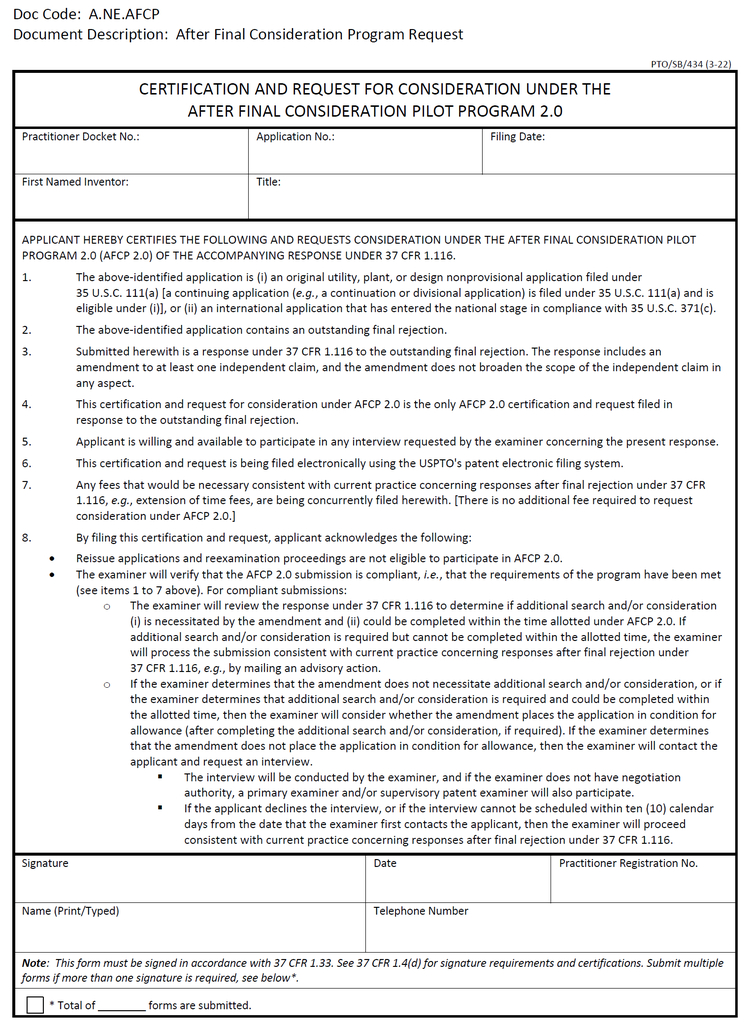
The key to making an AFCP request is to submit the required USPTO form along with an after-final amendment that meets the eligibility requirements discussed above. These requests must be filed electronically and not in hard copy by mail. The request form looks like this:

Image of main page of the USPTO's "Certification and Request for Consideration Under the After Final Consideration Pilot Program 2.0", form PTO/SB/434 (version 3-22)
USPTO AFCP 2.0 Certification and Request form PTO/SB/434 (version 3-22 shown)

Currently, there is no fee for this request. However, the USPTO has proposed an official fee requirement intended to go into effect in 2025.

The certification on the form indicates that the applicant is willing and able to conduct an interview. Nonetheless, substantive program materials contemplate that an applicant might later be unavailable or refuse an interview—contrary to what is stated at the end of section 8 of the USPTO’s certification and request form.

Is an AFCP Request Worthwhile?

Is it worthwhile, or a good idea, to make an AFCP request? Every case is different and there is no one correct approach. From an applicant’s perspective, an AFCP request is relatively easy to file. And the time needed for an interview may be short and not by itself a deterrent to making a request. So an AFCP request is often worth making if an independent claim is being amended. Whether it is desirable to amend a claim merely to qualify for AFCP 2.0 is another question entirely, and not something automatically recommended as a general matter (but possibly worthwhile in some circumstances).

This program tends to be most effective with relatively straightforward amendments. Or with amendments resulting from an examiner interview. Amendments implementing something essentially already suggested by the prosecution history tend to get a lot of benefit from it.

But the additional time allocated by an AFCP 2.0 request is not that large. That is particularly true if significant searching and consideration by the examiner is necessitated by a given response. Substantial, complex, or extensive amendments and/or arguments often require more examiner time to evaluate. These might not be resolved through the program. Applicants cannot expect miracles. All this is to say that after-final practice runs up against the count system and the time examiners are willing and able to allot to handling applicant responses. AFCP 2.0 may give examiners a little more time, but whether that additional time is enough time will vary widely on a case-by-case basis.

Photo of Austen Zuege

Austen Zuege is an attorney at law and registered U.S. patent attorney in Minneapolis whose practice encompasses patents, trademarks, copyrights, domain name cybersquatting, IP agreements and licensing, freedom-to-operate studies, client counseling, and IP litigation. If you have patent, trademark, or other IP issues, he can help.
Categories
Patents Q&A

What Is the Deadline to File a Continuing Patent Application?

A continuing patent application such as a divisional, continuation, or continuation-in-part (CIP) is possible in the USA. But what is the deadline to file one of these applications?

What Is a Continuing Patent Application?

A continuing patent application is one that claims priority to (or the domestic benefit of) a prior U.S. patent application or PCT international application that designated the USA. (See 35 U.S.C. §§ 120 and 121 and 37 C.F.R. § 1.53(b)). That means these are follow-on patent applications. They always relate back to one or more prior “parent” application(s). These can also be referred to as “child” applications in a patent “family”.

In other countries, the terminology for continuing applications may differ. For instance, many countries permit only subsequent “divisional” applications, and do not have different names for different types of continuing applications.

Deadline to file a Divisional, Continuation, or CIP Patent Application

Section 120 of the U.S. patent laws establishes that a continuing application (including divisionals, continuations, and CIPs) must be filed “before the patenting or abandonment of or termination of proceedings” of a parent application. In addition, USPTO regulations under 37 CFR § 1.78(d) state that a continuing application can be filed while the parent application is “copending”.

The Federal Circuit has ruled that so-called “same-day” continuing application filings are permitted, meaning a continuing application can be filed on the same day that a parent application issues as a patent. This confirmed longstanding U.S. Patent & Trademark Office (USPTO) practice, despite the statutory language literally saying “before” rather than “copending” or referring to the same day of patenting. Currently, this means that continuing applications can be filed up to and including the date that a parent application issues as a granted patent.

The USPTO’s tradition has been to issue new patents on Tuesdays. This aligns with publication of the USPTO’s Official Gazette for Patents. While that tradition is not formally codified as a rule/regulation and therefore might change in the future, the issuance of a patent will normally by no earlier than the next Tuesday following payment of the issue fee.

Another important aspect of the USPTO’s “copending” requirement is that the parent case cannot be abandoned. If the parent case will not issue, but an office action or the like is outstanding, then it is necessary to file the continuing application either (a) during the shortened statutory response period in the parent case or (b) after the shortened statutory period but before the maximum six-month statutory period along with the payment of monthly extension of time fees in the parent application. In other words, extension of time fees may be required in the parent case in order for the continuing application to be considered “copending”. This is referenced obliquely in MPEP § 710.02(e) and more clearly in old USPTO notices.

For continuing applications related to a prior PCT international application, such as a PCT “bypass” application in the U.S., the USPTO’s “copending” requirement means that the continuing application must be filed by the national phase entry deadline. In the U.S. this is 30 months from the earliest priority date.

The deadlines for continuing applications in other jurisdictions (often referred to only as divisionals) varies considerably. Deadlines for divisional or other continuing applications in foreign patent offices may arise much sooner than the deadlines under U.S. patent law and practice. For instance, Brazil requires divisional filing before a final office action or allowance is issued, which is a date that cannot be precisely determined in advance.

Best Practices

It is a best practice to file any continuing application as early as possible, and in the USA no later than with the payment of the issue fee or by the shortened statutory period deadline for a response in the parent case. While it may be possible to file a continuing application after such a date, problems and additional fees could arise.

For example, the Federal Circuit decision allowing continuing application filings on the same day as issuance of the parent is contrary to the literal language of the status, and might be overturned someday. There may also be filing system outages, illnesses or other complications that make a last-minute same-day filing difficult as a practical matter.

Also, the USPTO’s switch to “eGrant” electronic-only patents means that the delay between issue fee payment and subsequent issuance will become shorter than when hard copies were printed and mailed in the past. Indeed, on this point the USPTO has formally commented that reducing patent pendency is required by statute, while giving applicants time to file continuing applications is not, so “[a]pplicants should file their continuing applications as early as possible, preferably prior to payment of the issue fee to avoid any loss of rights.”

If an office action is outstanding in a parent case that will be abandoned, filing continuing applications early also avoids the need to pay an extension of time fee in the parent. The need to pay that extension of time fee in the parent might also be easily overlooked and missed, jeopardizing any resultant patent.

Also, delayed continuing application filings can implicate other considerations such as double patenting (and terminal disclaimers), prosecution laches, and the prior art status of a publication of a parent application (particularly for CIP applications).

Lastly, delays in filing a continuing application may also delay examination and erode the available term for any resultant utility or plant patent issuing from a continuing application. (However, this point is not a concern for design patents, which have a fixed term from issuance).

Photo of Austen Zuege

Austen Zuege is an attorney at law and registered U.S. patent attorney in Minneapolis whose practice encompasses patents, trademarks, copyrights, domain name cybersquatting, IP agreements and licensing, freedom-to-operate studies, client counseling, and IP litigation. If you have patent, trademark, or other IP issues, he can help.
Categories
Patents Q&A

What Is a Published Patent Application?

People unfamiliar with patents and patent law are often confused about published patent applications. This article provides a brief overview of what a published patent application is and, importantly, how it differs from a granted patent.

Contents of a Published Application

Pre-grant publication means that patent applications that have not yet been fully examined are published while still pending. This gives the general public a view of the contents of the pending application. And even if no patent is ever granted, the contents of the published application are normally still made public (with some exceptions). Published patent applications can be relied upon as prior art against later applications. In the USA, only non-provisional utility and plant patent applications are subject to pre-grant publication. Pre-grant publication normally occurs after eighteen months have elapsed from the earliest priority date.

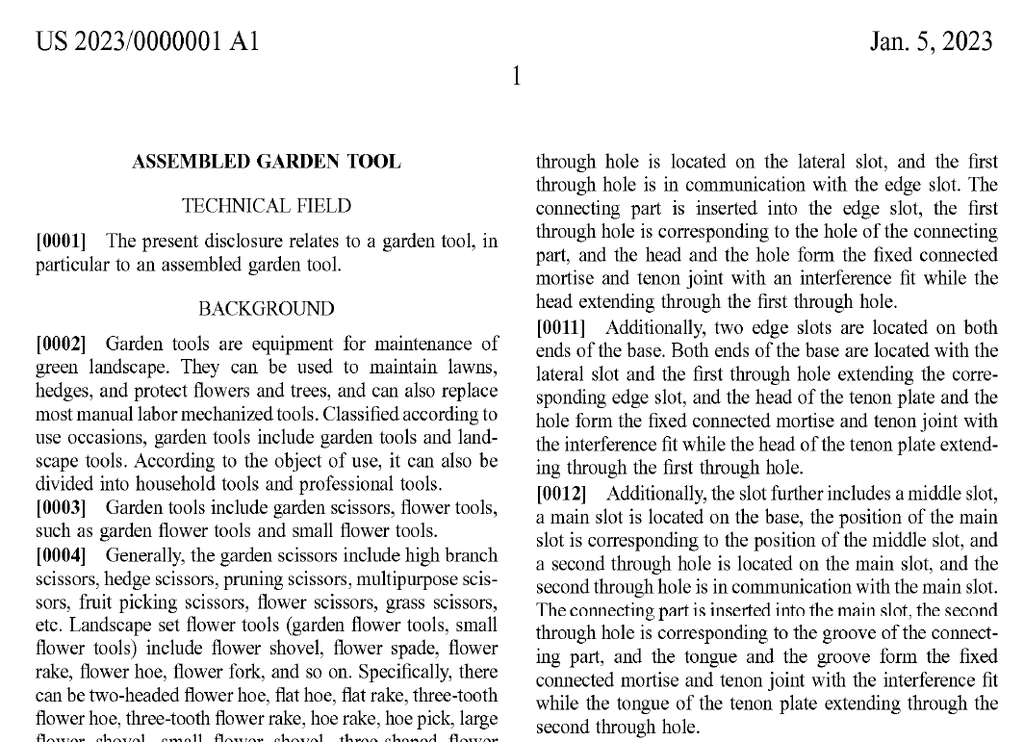
A published patent application—or patent application publication—will take a form determined the relevant jurisdiction. In the USA, for example, each application is specially formatted for pre-grant publication in a two-column format using paragraph numbers. This means the appearance of the published application will differ from what the applicant(s) originally filed.

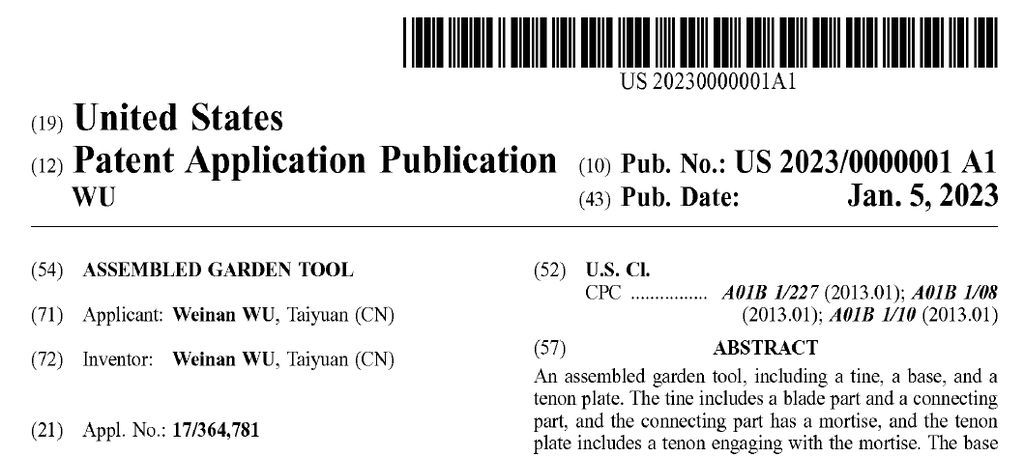
Excerpt of the front page of United States Patent Application Publication Number US 2023/0000001 A1 to Weinan Wu for an "Assembled Garden Tool"
Example excerpt from front page of U.S. patent application publication no. 2023/0000001
Excerpt of the first page of text of US 2023/0000001 A1 for an "Assembled Garden Tool" showing two-column format with paragraph numbers
Example excerpt from first page of text of U.S. patent application publication no. 2023/0000001

The published application might also include amendments, such as amendments to the claims or drawings. In some uncommon instances, amendments might be published that are later disallowed and omitted from a subsequent granted patent. But amendments submitted too late for inclusion might not be included with the publication. And appendices included in patent applications are generally not published. The USPTO can refuse to publish certain information prohibited by law or that is offensive or disparaging. Additionally, as a consequence of official preparations and formatting efforts for publication, there can sometimes be discrepancies and printing errors, in which the published version unintentionally differs from the applicant’s original application.

In some other jurisdictions, such a PCT application publications, published applications merely take copies of the application as filed by the applicant and add a cover sheet. In other words, the application is not reformatted and reflects what the applicant submitted.

Publication Numbers

Each patent application publication is assigned an official publication number. In the USA, and with PCT matters, the publication number differs from the application serial number assigned upon filing by the relevant patent office. Although in some jurisdictions the publication number may be the same or nearly the same as an application serial number.

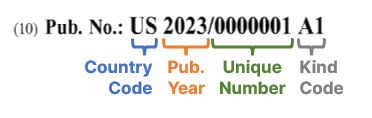
The anatomy of a publication number in the USA is shown as follows:

graphic labeling the country code, pub. year, unique number and kind code for the publication number of U.S. patent application publication no. US 2023/0000001 A1
Anatomy of a U.S. patent application publication number

There is a four-digit year followed by a slash followed by a seven-digit number unique to each published application, and the concluded with a kind code. The unique-seven digit numbers are sequentially assigned to each newly published application. The kind code indicates the type of publication, with “A” generally indicating a published application and “B” generally indicating a granted patent. A two-letter country-code prefix to patent publication numbers can also be present, or appended, to indicate the jurisdiction of the patent publication.

Be aware that some patent searching databases use confusing variations on official patent publication numbers and kind codes. For instance, the Espacenet portal from the European patent Office (EPO) truncates U.S. published application numbers and shortens the unique seven-digit number to a six-digit number (but dropping a leading zero). Also, some databases will retroactively apply an “A” kind code to old granted U.S. patents, from before the USPTO began printing kind codes on patents or making pre-grant publications at all.

Each jurisdiction has a slightly different format for publication numbers. For instance, PCT publication numbers have a “WO” country-code prefix and use a six-digit unique identification number.

Example publication number for PCT international publication number WO 2023/000001 A1, published in German
Example publication number for PCT international publication number WO 2023/000001 A1

Publication Makes File Wrapper Available Too

Before publication, the substantive contents of pending patent applications are kept confidential by the U.S. Patent & Trademark Office (USPTO). But upon publication, which normally happens after eighteen months from the earliest priority date, the file wrapper of a published patent application is also made public by the USPTO. This allows the public to monitor the status and ongoing prosecution history of the corresponding application. While the “published application” is a discrete, stand-alone document, its publication also makes other information publicly available too. But, strictly speaking, a published application refers only to the stand-alone published version of the application and not to other materials in a file wrapper made available to the public through other channels.

Differences From a Granted Patent

A published patent application is much different from a granted patent (also called an issued patent). This is often misunderstood. Although the differences between published applications and granted patents are very significant.

In all but a few countries, patent applications must undergo a substantive pre-grant examination that establishes patentability before a patent is granted. A pre-grant patent publication merely indicates that the applicant(s) are seeking—or previously sought—a patent. But there are no enforceable patent rights unless and until a patent is granted. The existence of a published application for an application that is still pending simply means that a patent might be granted. Plus, the scope of the claims in any later-granted patent may differ from those in the published application. By way of analogy, just because someone files a lawsuit does not mean that he or she will win the case or that all the allegations are all true.

A common mistake is to refer to a published patent application as a patent. But they are not patents! It is reasonable to call them patent documents, or patent-related documents. But a published application is not directly enforceable by itself. Only a granted patent can be enforced. This is the most important distinction. A published patent application does not present immediate and direct infringement risks like a granted patent. Although the technical teachings and disclosures in a published patent application may still be prior art against later patent application claims. Yet a published application and a later related patent are often merely cumulative, meaning (apart from different publication dates) they are redundant in terms of their substantive teachings.

Another potentially confusing aspect of published patent applications is that you cannot understand the current status of the underlying patent application from the published patent application alone. A given published application may have matured into a granted patent since publication, or might have been abandoned (and/or another related “child” application might have been filed too). It is necessary to look up the current status in official records, such as though the USPTO’s Patent Center portal. Most paywalled, proprietary patent searching databases provide at least some status information, and a few (but definitely not all) free, open-access patent searching databases provide some status information. But finding and interpreting current status information is not always straightforward.

Photo of Austen Zuege

Austen Zuege is an attorney at law and registered U.S. patent attorney in Minneapolis whose practice encompasses patents, trademarks, copyrights, domain name cybersquatting, IP agreements and licensing, freedom-to-operate studies, client counseling, and IP litigation. If you have patent, trademark, or other IP issues, he can help.
Categories
Patents Q&A

When Are Patent Applications Published?

Most patent applications are normally published while still pending and prior to the grant/issuance of a patent. Such publication allows the public to see the contents of the application and expands the publication of technical information to include applications that do not turn into granted patents. But when does this pre-grant publication normally occur? And are there any exceptions or variations in the normal publication schedule? This article addresses issues around when patent applications are published occur prior to grant.

When Publication Normally Occurs

In the USA, any new utility or plant patent application is normally published after eighteen (18) months have elapsed from the earliest filing date. The 18-month publication period is based on the earliest effective filing date or priority date. So if there was a prior provisional or foreign priority application, or the application is a continuing application, the 18-month timeline runs from the earliest priority or “parent” application’s filing date rather than the filing date of the current application. Publication normally occurs as soon as possible after the 18-month deadline arrives. In practice, there may be administrative delays in publication. As a result, it might not always happen at exactly eighteen months.

However, U.S. design patent applications and provisional patent applications are never published before grant (35 U.S.C. § 122(b)(2)(A)). Also, reissue patent applications are not published because they always relate to a prior patent that was already granted and therefore already publicly available.

PCT international patent applications are also published after eighteen months (PCT Art. 21). Most other jurisdictions publish patent applications after eighteen months too. Sometimes this public availability in other countries is referred to as providing “laid open” patent applications.

Exceptions to the Normal Publication Schedule

There are some exceptions to the default 18-month pre-grant publication of utility and plant patent applications.

Sometimes pre-grant publication is delayed or does not occur at all. In the USA, applicants can expressly request non-publication, which is only possible if no foreign patent protection is sought. If a non-publication request is filed, the patent and related file wrapper contents only become accessible when a patent is granted, if at all. There can also be secrecy orders that delay publication (and grant of a patent) when the application’s subject matter implicates national security interests. And applications that are no longer pending at eighteen months are not published. That situation arises if a patent is granted in less than eighteen months or if an applicant files a timely express abandonment request.

It is also worth noting that pre-grant publication only began in the U.S. starting with applications filed on or after November 29, 2000. So pre-grant publications simply did not exist in the USA prior to that time frame. Although pre-grant publications have existed in many other countries for a much longer time.

Occasionally pre-grant publications will occur earlier than the usual 18-month schedule. For instance, applicants in the U.S. can expressly request early publication and/or republication, although such requests are rare.

Photo of Austen Zuege

Austen Zuege is an attorney at law and registered U.S. patent attorney in Minneapolis whose practice encompasses patents, trademarks, copyrights, domain name cybersquatting, IP agreements and licensing, freedom-to-operate studies, client counseling, and IP litigation. If you have patent, trademark, or other IP issues, he can help.
Categories
Patents Q&A

What Is Prior Art?

The phrase “prior art” is used extensively in relation to patents and patenting. But what is prior art? What does this term refer to? The following article will explain how this term is used in patent law.

Basic Overview

Prior art refers to what was already known that is relevant to patentability. More particularly, it is qualifying existing knowledge that is relevant to questions of novelty and nonobviousness (or inventive step), which are two requirements for patentability, for an invention recited in a given claim of a patent or patent application.

Of course, there are some further nuances here about what exactly is considered relevant to patentability and what is not, and what legally qualifies as prior art under applicable law. Many of those nuances are explained further below.

Prior Art is Old Knowledge

First of all, prior art has to be old enough. It always has to be something that was already known or came before before a particular date associated with a given patent or patent application. So the “prior” part of the term “prior art” means something was known sufficiently earlier or before what given inventor(s) are claiming is their patentable invention. This is about dividing technical knowledge into older stuff that might call the patentability of an invention into question and later stuff that might infringe claim(s) of a patent to that invention.

For any given patent or patent application, there is a critical date that establishes what is old enough to be prior art. Something before the critical date is prior art and anything after is not. The point in time that constitutes a critical date will be established by the patent laws of a particular jurisdiction. It can vary based on whether a jurisdiction follows a first-to-file patent system or a first-to-invent patent system, for example. It can also vary on a claim-by-claim basis—there may be different priority dates for different claims, which means some things may be prior art against certain claims but not others.

Prior Art is Knowledge of Useful Arts

The “art” part of the term “prior art” refers to knowledge about the useful arts. The “useful arts” is basically an old-fashioned term that refers to technical knowledge pertaining to what today is more commonly called science and engineering. Just as there are different fields of science and engineering, there are different types of arts. So this term is not limited to any particular area or kind of technical knowledge. But it does not refer to paintings, sculptures, or similar artworks that might appear in a museum.

The term “prior art” can refer to the collective body of relevant prior technical knowledge. That means it is proper to say that something falls within the prior art, as in being a part of that body of pre-existing knowledge. It is common to refer to a “prior art reference”, “prior art product”, or the like in reference to a particular instance of something that qualifies (or allegedly qualifies) as prior art.

Prior Art is Essentially Public Knowledge

In general, prior art refers to information that was sufficiently accessible to the public. This might have been in the form of commercially-available products or services, or in the form of articles, books, videos, etc. Importantly, something that was “secret” and not available to the public usually will not qualify as prior art. For instance, an unpublished draft of a book or article will not qualify as prior art. But there are some exceptions that may allow certain secret or confidential activities to qualify as prior art, mainly relating to confidential on-sale activities.

A crucial exception (at least in the USA) is that any sale or offer for sale can potentially qualify as prior art. The U.S. on-sale bar still applies to prior confidential, private, or otherwise secret commercial sales or offers for sale. In other words, a confidentially or non-disclosure (NDA) agreement will not remove something that was on sale from the realm of prior art. Such confidential sales still involve a third-party (who is part of the public) gaining access to an invention. Also, inventor(s)’ own prior activities can potentially be used as prior art against the inventor(s)’ later patent application or patent, unless the inventor(s)’ application was filed in the statutory grace period.

Laws Vary By Jurisdiction

Prior art is also something defined by the patent laws of a given jurisdiction. This means that definitions of what is and is not considered prior art can and do vary between different countries. There is no universal harmonization of patent laws in this respect. So it is possible something might qualify as prior art in one country but not in another.

In the USA, what constitutes prior art is set out in § 102 of the patent laws (35 U.S.C. § 102). This portion of the current patents laws is written in a very confusing manner. But it establishes that prior art can include a patent, a published patent application, a printed publication (which can also include patents and published patent applications), products or processes that were in public use or on sale, as well as things that were otherwise available to the public before the effective filing date of the claimed invention. U.S. patent law also contain some exceptions that can disqualify certain references from being used as prior art.

In other countries, however, the patent laws may differ significantly. For instance, some countries have no on-sale bar, only a public use bar to patenting. This means that secret or confidential sales may not qualify as prior art, even if those prior secret sales involved the identical invention. And few other countries have a filing grace period like the U.S. Some jurisdictions may also have limits on the use of prior art, such as making an applicant’s prior patent applications available as prior art only for novelty determinations but not inventive step/obviousness determinations. It is important to consider laws of each relevant jurisdiction separately, because differences in laws can mean that what qualifies as prior art differs between jurisdictions.

Laws Change Over Time

What qualifies as prior art can also change over time in a given jurisdiction as laws are modified or interpreted by courts.

U.S. patent laws have changed over time, including modifications to the definitions of what does and does not qualify as prior art. Significantly, the America Invents Act (AIA) had provisions that went into effect March 16, 2013 that eliminated certain first-to-invent provisions and altered other aspects of what qualifies as prior art. For example, the AIA eliminated certain geographic restrictions on what qualifies as prior art—no longer requiring that certain things happen in this country (i.e., in the USA) to be prior art. Patents and patent applications with pre-AIA effective filing dates are therefore subject to different definitions of what qualifies as prior art than post-AIA ones. Laws in other countries have also changed over time.

Photo of Austen Zuege

Austen Zuege is an attorney at law and registered U.S. patent attorney in Minneapolis whose practice encompasses patents, trademarks, copyrights, domain name cybersquatting, IP agreements and licensing, freedom-to-operate studies, client counseling, and IP litigation. If you have patent, trademark, or other IP issues, he can help.
